
Guide
How to compare HVAC quotes line by line

Rich Jagisch
Director of Growth
11 minute read
11/17/2026
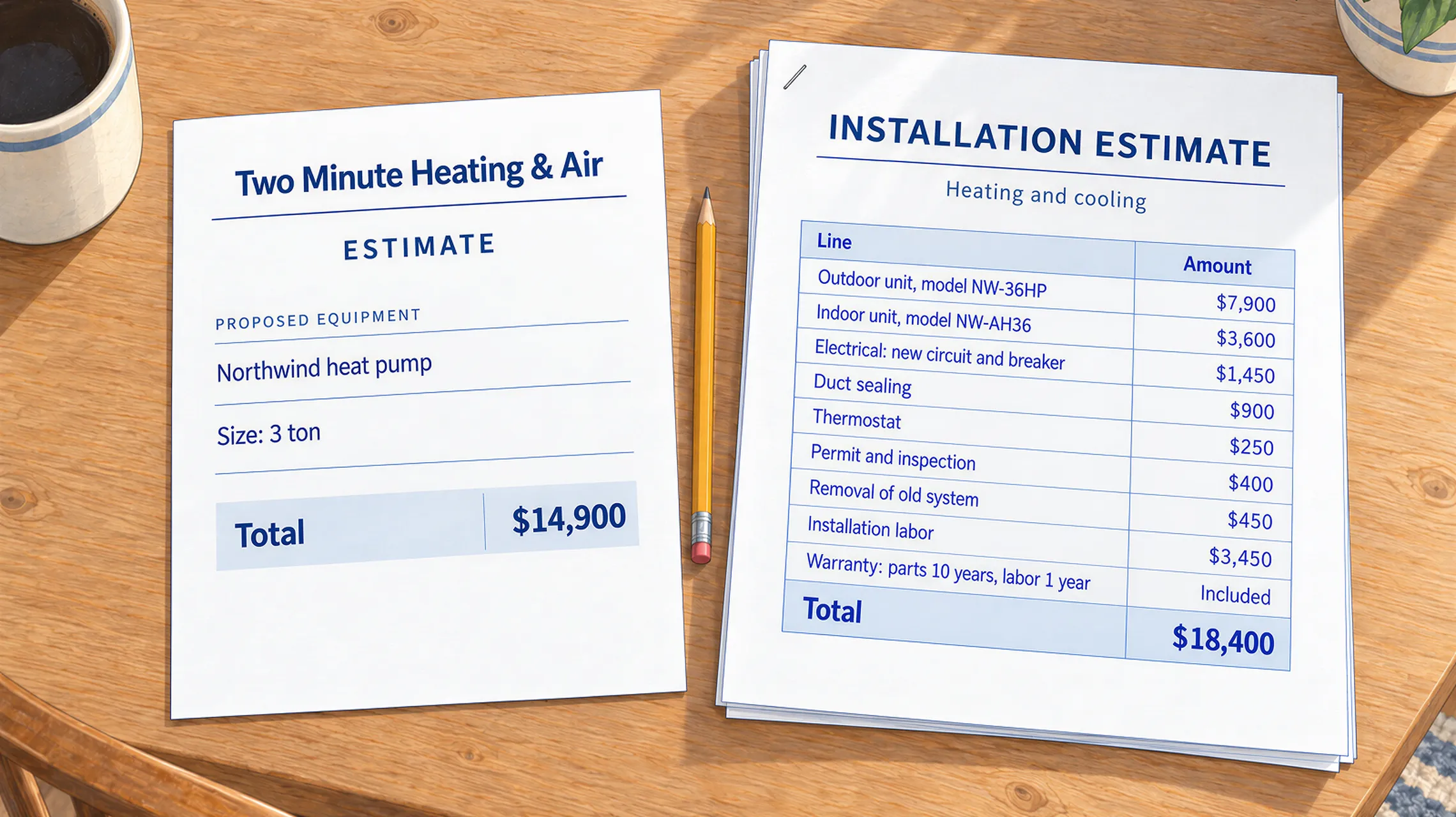
To compare HVAC quotes, read the lines, not the totals. The number at the bottom tells you very little until you know what's in it.
A complete quote for a new furnace, air conditioner or heat pump runs to about fifteen lines. It names the equipment by model number. It shows how the system was sized for your house. It covers the electrical work, the permit, the removal of the old system and the warranty. A quote written after a two-minute walkthrough has three lines: a brand, a size and a price.
That is why two quotes for the same house can differ by thousands of dollars. The cheaper one usually left something out. From what homeowners tell us on calls, it's most often the extended warranty, the electrical work or the sizing. This guide goes through all fifteen lines, so you can set two quotes side by side and see what's missing.
Key takeaways
Put every quote into the same fifteen-row table. The blank rows explain most of the price difference.
The lowest bid most often leaves out three things: labor warranty coverage, the electrical work, and a calculation to size the system.
Ask for model numbers first. Without them you can't compare equipment or check a warranty.
The permit, the removal of the old system and the final testing are part of the job. If a quote doesn't list them, ask.
The lowest total is not always the lowest cost. Federal consumer guidance says not to choose the lowest bidder automatically [11].
What should an HVAC quote include? The fifteen lines
Print this table or copy it into a spreadsheet. Give each quote its own column. You aren't grading the contractors. You're looking for blanks.
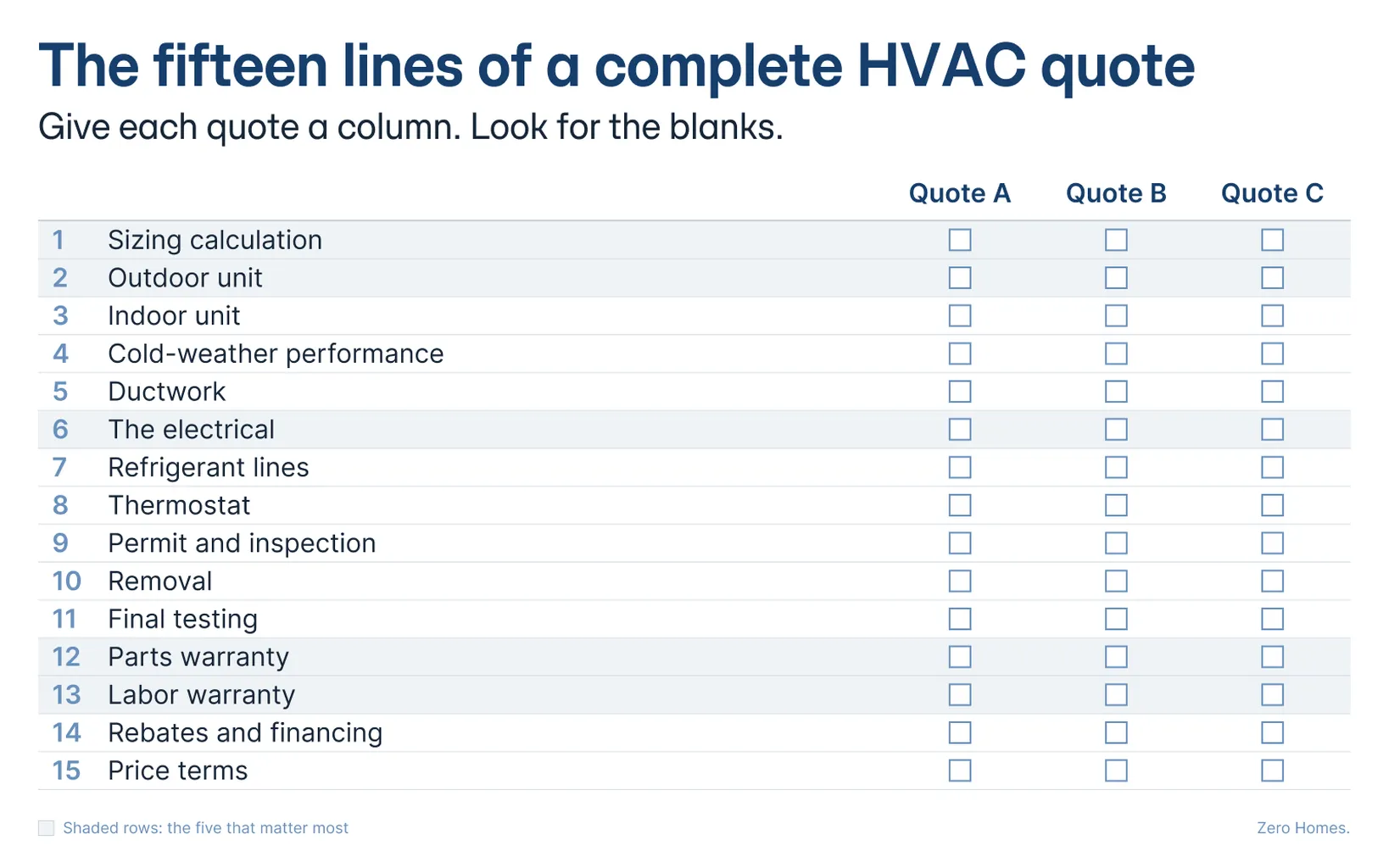
The list follows what federal guidance tells homeowners to ask for. ENERGY STAR advises getting written, itemized estimates, and a signed proposal that specifies costs, model numbers, schedule and warranty [1].
| # | Line | A complete quote says | A two-minute quote says | Ask |
|---|---|---|---|---|
| 1 | Sizing calculation | How much heating and cooling the house needs, worked out room by room | Nothing, or "same as existing" | "How did you size this, and can I see the calculation?" |
| 2 | Outdoor unit | Make, full model number, size and efficiency rating | A brand and a size | "What's the model number?" |
| 3 | Indoor unit | Make and model, and whether the fan runs at one speed or many | Often left out | "Which indoor unit is this?" |
| 4 | Cold-weather performance (heat pumps) | How much heat the unit delivers at 5°F | Not mentioned | "How much heat does it make at 5°F?" |
| 5 | Ductwork | What will be reused, sealed, changed or replaced | "Connect to existing" | "Did you check the airflow in my ducts?" |
| 6 | The electrical | The wiring and breaker the system needs, and whether your panel has room, with a price | Missing, or "electrical by others" | "Is the electrical in this price?" |
| 7 | Refrigerant lines | New lines, or the old ones cleaned and reused | Missing | "New lines or reused?" |
| 8 | Thermostat | The model, and whether it's included | Missing, or just "smart thermostat" | "Is the thermostat matched to this equipment?" |
| 9 | Permit and inspection | The contractor gets the permit and schedules the inspection | Missing | "Who pulls the permit?" |
| 10 | Removal | The old equipment is hauled away, and its refrigerant is recovered | Missing | "Is removal included?" |
| 11 | Final testing | The system is tested in heating and cooling before the crew leaves | Missing | "What do you test before you leave?" |
| 12 | Parts warranty | The manufacturer's term, usually 10 years, and who registers it | "10-year warranty" | "Is that parts or labor?" |
| 13 | Labor warranty | How many years the installer covers labor, and what longer coverage costs | Not separated from parts | "How long is labor covered?" |
| 14 | Rebates and financing | Each program by name, the price after rebates, and any loan terms | A total "after rebates," with no detail | "Which programs, and who files them?" |
| 15 | Price terms | How long the price holds, and what could change it | "Valid 7 days" | "What could change this price on install day?" |
Five rows matter most: 1, 2, 6, 12 and 13. If a quote has those, you can compare it with any other. If it doesn't, you can only compare its total with another incomplete total. That's how people end up choosing between two numbers that don't mean much.
Row 4 matters to anyone weighing a heat pump in Colorado. We explain what to look for in cold climate heat pump: what qualifies.
For a shorter version of this check, see have a quote that doesn't feel right?
What does the cheap bid usually leave out?
Three things, according to our sales team. They hear the same gaps whenever a homeowner reads another company's quote aloud on a call [2].
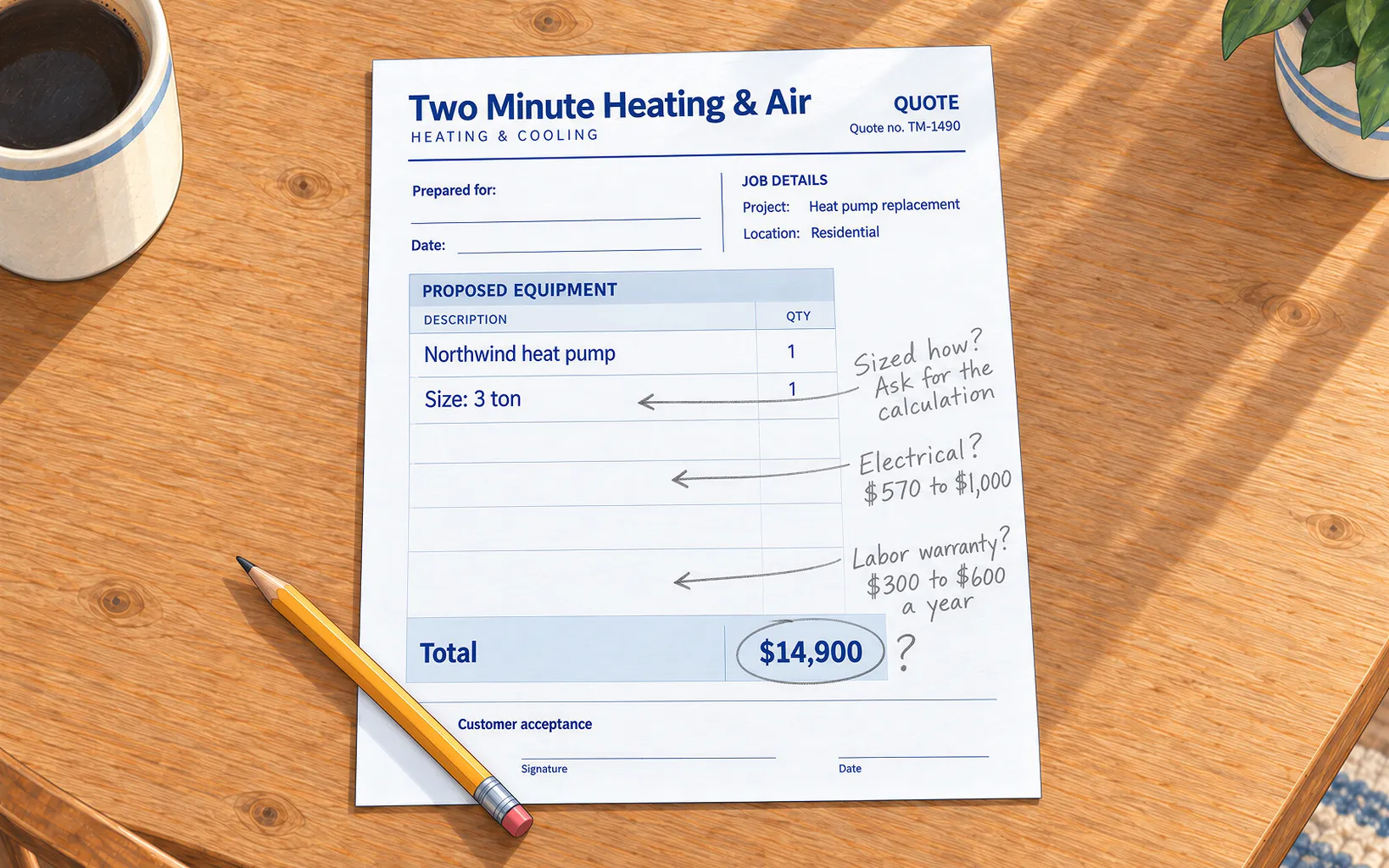
The labor warranty. Almost every quote says "10-year warranty." That's the manufacturer's warranty on parts. It comes with the equipment, whoever installs it. Even that has a catch. Carrier's parts coverage runs 10 years only if the equipment is registered within 90 days. Otherwise it drops to five [3].
Labor is the part that varies. The manufacturer's warranty doesn't cover it [3]. So who pays the technician when a part fails in year four? Some installers include a year of labor [3]. Others sell extended coverage as a separate plan, which averages $300 to $600 a year [4]. Some say nothing and send a bill.
Callers ask us about this directly. They want to know whether we only pass along the manufacturer's warranty, or whether we cover labor too. It's the right question to put to any installer. We go through the terms in HVAC warranty: what's actually covered.
The electrical. A heat pump needs its own circuit, the right breaker and a panel with room for both. So do many new furnaces and air conditioners. The cheapest bids tend to leave this out, usually with the words "electrical by others."
It comes back on install day as an extra charge, from an electrician you didn't choose. A new dedicated circuit typically costs $570 to $1,000 [5]. If the panel has to go from 100 amps to 200, add $1,500 to $3,000 [6]. The answer belongs on the quote, either priced or ruled out. See does a new furnace or heat pump need electrical work?
The size. The lowest bid is often for a system the same size as the old one. The size is read off a label in the basement, which takes two minutes. No one calculates what the house needs. That calculation, called a Manual J, is the national standard, and most building codes require it [7].
The trouble is that the old system was probably too big. The Department of Energy says heating systems, old and new, are often oversized [8]. That would explain a hot upstairs, or a furnace that keeps starting and stopping in October. We explain the calculation in what size furnace do I need, and is mine oversized? The heat pump version is in what size heat pump do I need? For what the wrong size does, see why is my furnace short cycling?
Now add those three lines back into the cheap bid. In our experience, most of the gap between quotes closes. What remains is a real difference in equipment and workmanship. That's a better thing to decide on.
Where do the lines come from?
A quote can fill all fifteen rows only if someone measured the house first. Here is how our design team does it.
The homeowner scans the house with a phone. It takes a few minutes per floor. Our engineers turn the scan into a floor plan. Then they calculate how much heat the house loses through its walls, windows and insulation. The method is called a Manual J.
Next they model how the chosen system will perform at every outdoor temperature. They adjust for elevation, because heating equipment delivers less in thin air. A typical gas furnace, for example, loses 4 percent of its output for every 1,000 feet above 2,000 feet [9].
Rows 1 through 4 come from that model. Rows 5 through 11 come from the scan and from photos of the existing equipment, panel and ducts. In Denver, replacing a system with a heat pump requires a permit application through the city's e-permits system [10]. The warranty rows read the same on every quote: a 10-year manufacturer parts warranty, which we register, and a 1-year installation warranty. The quote arrives within 24 hours of the scan. The price holds through installation unless the job itself changes.
You can read a real quote on our sample quote page, with the homeowner's details removed. Every row has a value.
There is a trade-off. The scan takes about 15 minutes of your time. A walkthrough estimate takes none.
Why are HVAC quotes so different for the same house?
There are four reasons. Where a published figure exists, it's in the table. Where none does, we say so.
| Reason | What it can add | How to tell |
|---|---|---|
| Missing lines, such as the electrical work or labor coverage | $570 to $1,000 for a new circuit [5]. $1,500 to $3,000 for a panel upgrade [6]. $300 to $600 a year for extended coverage [4]. | Count the blank rows in the table above |
| Different equipment, such as a basic unit against a cold-climate model | Varies widely by model. We found no reliable published range. | Compare model numbers, not brands |
| Different work included, such as duct changes or new refrigerant lines | Varies by house | Rows 5, 7 and 8 |
| Different overhead and profit | Varies by company | Whatever is left once the rows above match |
Start with the first two rows. Both are easy to see once the quotes share a table. ENERGY STAR makes the same point about price: the lowest one may not be the best deal [1].
What if two quotes match on every line and still differ by thousands? Ask the more expensive company why. Sometimes there's a good answer. A crew that tests its work carefully costs more. Sometimes there isn't one. For judging the company behind the quote, see how to choose a heat pump installer.
What a complete quote won't do
It won't have the lowest total. A complete quote includes the electrical work and labor coverage. It will often cost more than the two-minute quote. It will often cost less than the two-minute quote plus the surprise charges that follow.
Ours won't quote you a furnace. We design and install heat pumps, which heat and cool with one system. If your other quotes are for a gas furnace and a separate air conditioner, you're comparing two different things. And we don't claim a heat pump will save you money. In Colorado, gas costs less than electricity for the same amount of heat. A fair comparison covers a full year, old system against new. You'll find it in heat pump vs furnace.
It won't fix the house. A sizing calculation shows what the house needs. If the attic has no insulation or the ducts are too small, the quote will say so, and we can help you sort out the fix.
It won't be beyond argument. Two engineers can size the same house slightly differently, and both can defend the result. A complete quote shows you the reasoning, so you can ask about it.
Frequently asked questions
Sources
ENERGY STAR, "10 tips for hiring a heating and cooling contractor." https://www.energystar.gov/saveathome/heating-cooling/10-tips-hiring
Zero Homes analysis of 4,977 customer call transcripts, August to September 2026.
Carrier, "Carrier warranty registration and information." https://www.carrier.com/us/en/residential/homeowner-resources/warranty/
ConsumerAffairs, "HVAC warranties: coverage and cost," by Alina Bradford, updated November 13, 2026. https://www.consumeraffairs.com/homeowners/hvac-warranties.html
HomeAdvisor, "How much does it cost to install a dedicated circuit?" https://www.homeadvisor.com/cost/electrical/cost-to-install-a-dedicated-circuit
Inch Calculator, "Cost to upgrade an electrical panel," updated August 14, 2023. https://www.inchcalculator.com/electrical-panel-upgrade-cost-guide/
Air Conditioning Contractors of America, "Manual J residential load calculation." https://www.acca.org/Manual-J
U.S. Department of Energy, Energy Saver, "Furnaces and boilers." https://www.energy.gov/energysaver/furnaces-and-boilers
ACHR News, "Furnaces must be modified for high-altitude applications," by Joanna R. Turpin, November 27, 2017. https://www.achrnews.com/articles/136057-furnaces-must-be-modified-for-high-altitude-applications
City and County of Denver, Community Planning and Development, "Permitting a heat pump." https://www.denvergov.org/Government/Agencies-Departments-Offices/Agencies-Departments-Offices-Directory/Community-Planning-and-Development/Building-Codes-Policies-and-Guides/Denver-Energy-Code/Denver-Commercial-Energy-Code/Permitting-a-Heat-Pump
Federal Trade Commission, "How to avoid a home improvement scam." https://consumer.ftc.gov/how-avoid-home-improvement-scam
Have a quote that doesn't feel right? Talk to the experts. Our engineers can design a system for your house from a scan you take with your phone. You'll get a quote with every line filled in within 24 hours. [See a real quote](/sample-quote).