
Guide
HVAC warranty: what's actually covered

Rich Jagisch
Director of Growth
6 minute read
11/17/2026

An HVAC warranty usually covers the parts for 5 to 10 years. It usually doesn't cover the labor to replace them. That one gap explains most of the confusion, and most of the surprise bills.
There are really three warranties in play. The manufacturer covers the equipment. The installer covers the workmanship. And an optional paid plan may cover labor after that. Each has its own length, its own fine print and its own place on your quote.
Here is what each one covers, what can void it, and what to ask before you sign.
Key takeaways
The manufacturer's warranty covers parts, not labor. On Carrier equipment it runs 5 years, or 10 if the system is registered within 90 days.
The installer's warranty covers the work itself. Its length varies, so get it in writing.
Extended plans cover labor after that. Published prices run $300 to $600 a year.
A home warranty is a different product. Most won't cover a system still under its manufacturer's warranty.
When two quotes are far apart, check whether one includes an extended plan and the other doesn't.
What does an HVAC warranty cover?
Think of it as three layers.
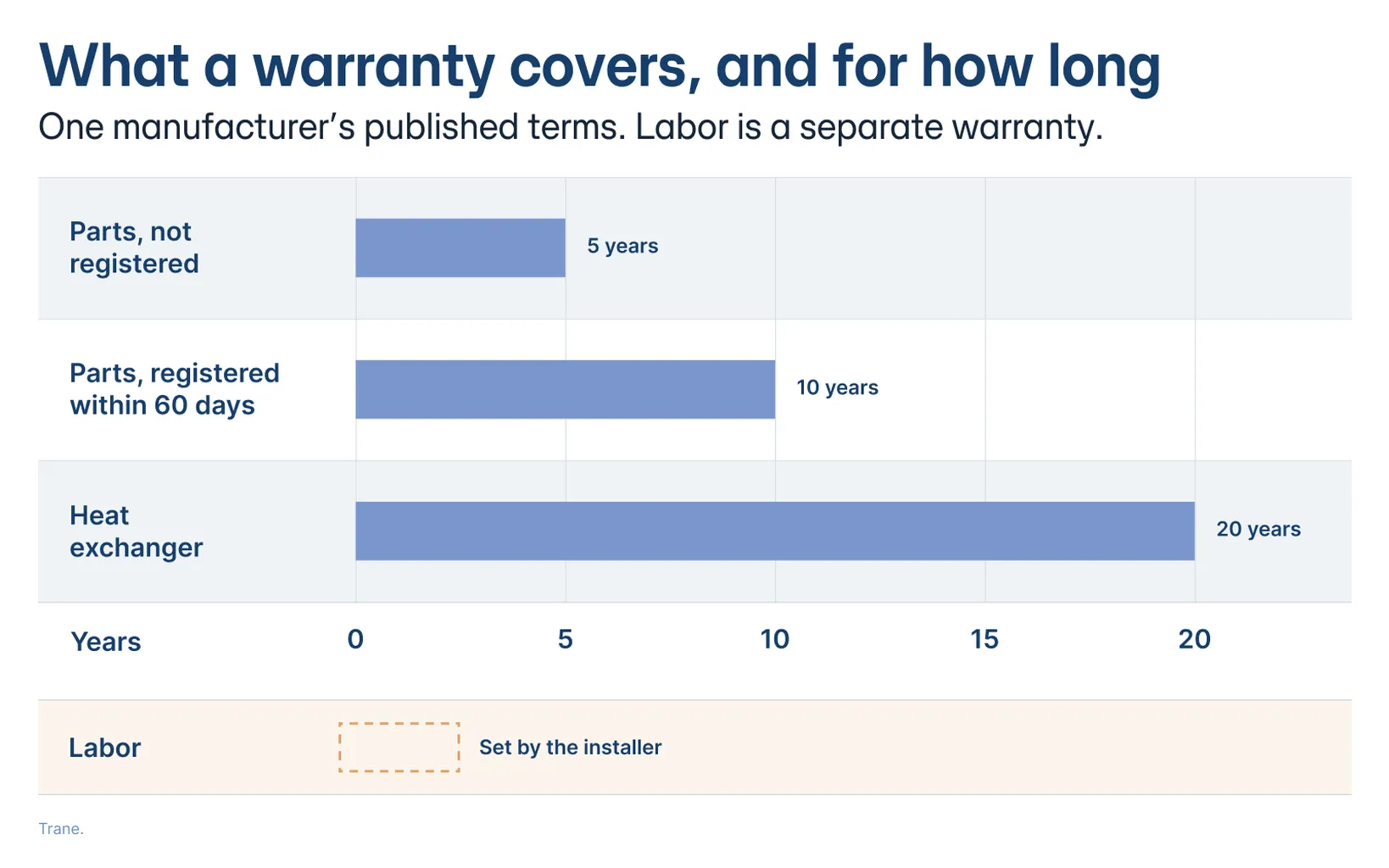
| Layer | Who backs it | What it covers | Typical length |
|---|---|---|---|
| Parts warranty | The manufacturer | A failed part | 5 years, or 10 if registered |
| Installation warranty | The installer | Workmanship and labor | Varies by installer |
| Extended plan | The installer or a third party | Labor, and sometimes parts, after the first two end | Sold by the year |
The parts figures are Carrier's published terms [1]. Carrier is one of the brands we install. Check the terms for your own brand. The base warranty is 5 years, parts only. Register the equipment within 90 days and it becomes 10 [1]. If your installer takes part in Carrier's program, you can choose 5 years of parts plus 3 years of labor instead [1].
Notice what the first layer leaves out. Carrier describes both the 5-year and the 10-year warranty as parts-only [1]. HomeGuide makes the same point about blower motors. If the unit is under warranty, the manufacturer supplies the part, but most warranties don't pay the technician [2].
So a "10-year warranty" means a free part in year 7. It doesn't mean a free repair.
What isn't covered?
Three things catch people out.
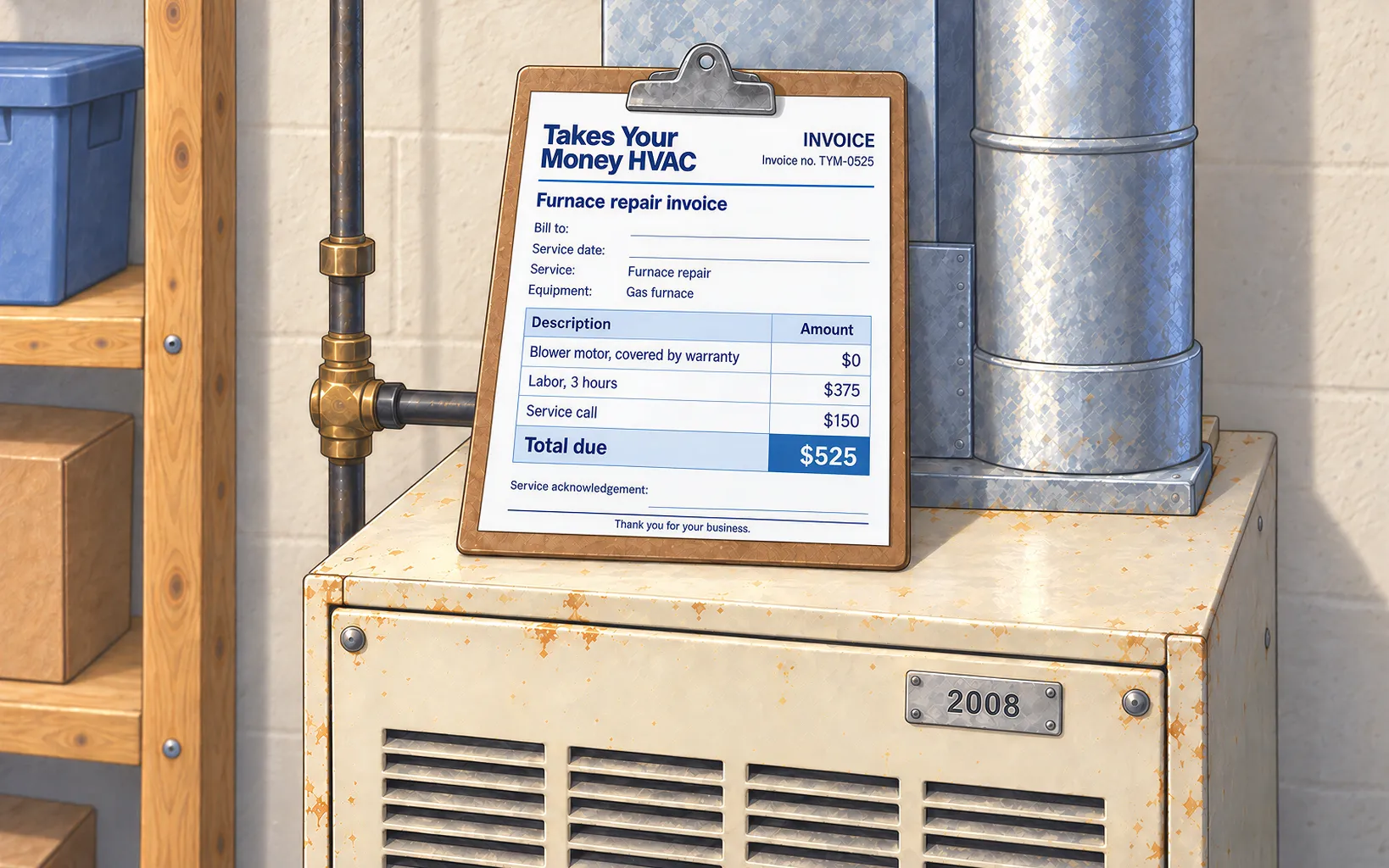
Labor. This is the big one. A blower motor takes 2 to 3 hours to replace, at $75 to $150 an hour [2]. The warranty covers the motor. You cover the hours.
An unregistered system. Miss Carrier's 90-day window and the 10 years become 5 [1]. Ask your installer who registers the equipment, and ask for the confirmation.
Work by someone unqualified. Replacing a part yourself can void the warranty [2]. Keep the records of each annual service in any case.
Is an extended HVAC warranty worth it?
Sometimes. An extended plan is a bet that labor costs after year one will exceed the price of the plan.
ConsumerAffairs puts extended coverage at $300 to $600 a year [3]. A typical furnace repair, by comparison, costs $125 to $500 [4].
The plan makes more sense as the system ages and the installer's warranty has long expired. It makes less sense in the first few years, when the equipment is new and the parts are covered anyway.
Before you buy one, ask three questions.
Who backs the plan? The installer, the manufacturer or a third company?
Does it cover labor only, or parts too?
Does it transfer if you sell the house?
Does a home warranty cover HVAC?
Often, with limits. A home warranty is a service contract you pay for separately. It typically covers repairs to household systems, including air conditioning [5].
It is not the same as the warranty on new equipment. NerdWallet's review of the major plans found coverage caps of $2,000 to $6,500 per system and a service fee of $75 to $125 per claim [6]. Most plans won't cover a system that's still under its manufacturer's warranty [6]. Many require proof of routine maintenance, and some pay out less as the system ages [6].
The Federal Trade Commission's advice is to read the limits before you buy. A plan may cover only part of a product, cap the reimbursement or be hard to use when you need it [5]. In the agency's words, a home warranty "is only as good as the company responsible for coverage" [5].
Where does the warranty show up on a quote?
This is where it matters most. Our sales team often reads quotes that differ by thousands of dollars. The warranty is one of three places the gap usually hides. The other two are the electrical and the size of the system.
It works in both directions. A high quote may include a multi-year labor plan as a line item. Take it out and the two bids are closer than they looked. A low quote may include no labor coverage past the first month. Add it back and the low bid isn't as low.
Neither is wrong. They're different products. Ask each bidder to write down four things.
The length of the parts warranty, and whether that assumes registration.
The length of the labor warranty, and who performs the work.
Any extended plan, priced as its own line.
Who registers the equipment, and by when.
For the full comparison, see how to compare HVAC quotes line by line.
What our own warranty does and doesn't do
Zero Homes installation carries a 10-year manufacturer parts warranty and a 1-year installation warranty, in most cases.
That means the same thing it means everywhere else. For 10 years, a failed part is replaced by the manufacturer. For the first year, the labor is ours. After that first year, labor on a covered part is a cost.
We'd rather say that plainly than advertise "10 years" and let you assume the rest. If long labor coverage matters to you, price an extended plan next to any quote, including ours.
Frequently asked questions
Sources
Carrier, "Carrier warranty registration and information." https://www.carrier.com/us/en/residential/homeowner-resources/warranty/
HomeGuide, "How much does blower motor replacement cost?" https://homeguide.com/costs/blower-motor-replacement-cost
ConsumerAffairs, "HVAC warranties: coverage and cost," by Alina Bradford, updated November 13, 2026. https://www.consumeraffairs.com/homeowners/hvac-warranties.html
HomeGuide, "Furnace repair cost." https://homeguide.com/costs/furnace-repair-service-cost
Federal Trade Commission, "So what's the deal with 'home warranties'?" by Kira Krown, February 24, 2023. https://www.consumer.ftc.gov/consumer-alerts/2023/02/so-whats-deal-home-warranties
NerdWallet, "Does a home warranty cover HVAC?" by Whitney Vandiver, updated November 19, 2025. https://www.nerdwallet.com/article/mortgages/does-a-home-warranty-cover-hvac
Every Zero Homes installation carries a 10-year manufacturer parts warranty and a 1-year installation warranty. Both are written on the quote before you sign. [See how a Zero Homes quote is built](/how-it-works).