
Guide
Furnace leaking water: causes, and when it's the end of the line

Rich Jagisch
Director of Growth
5 minute read
11/17/2026
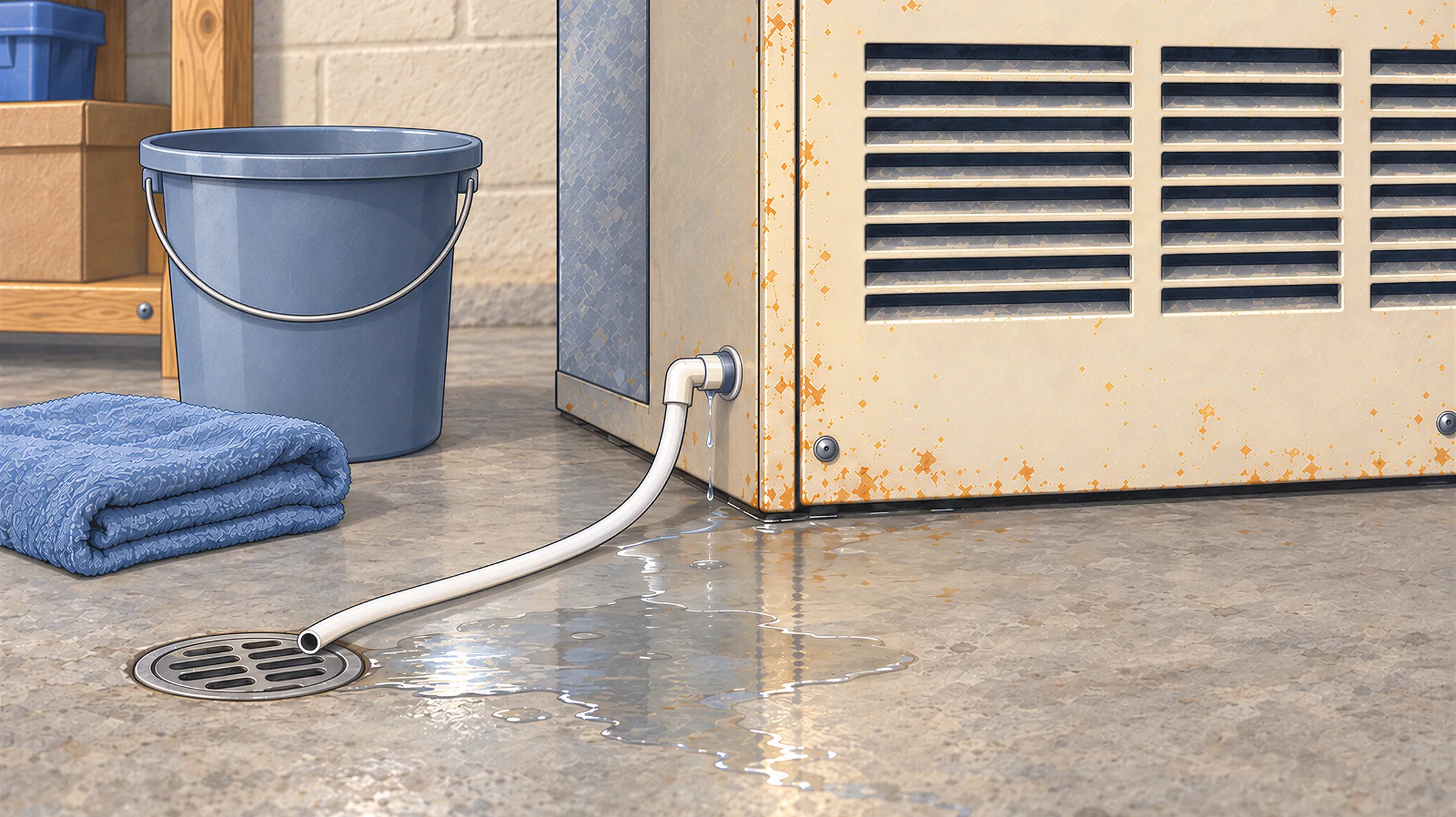
A furnace leaking water usually has a clogged drain. High-efficiency furnaces produce water as they run, and that water leaves through a small drain line. When the line clogs, the water backs up and ends up on the floor.
That's the common case, and it's a minor repair. The rare case is serious. Water can also be a sign of a damaged heat exchanger, which is a safety problem.
Here is how to tell them apart, what to do first, and when a leak means the furnace is finished.
Key takeaways
A clogged condensate drain is one of the most common causes of a furnace leak.
Only high-efficiency furnaces make water in normal operation. If yours isn't one, look at the humidifier or the air conditioner's drain.
Turn the furnace off if water is near electrical parts or you can't find the source.
A leak caused by a damaged heat exchanger needs a technician right away.
On a furnace over 15 years old, a heat exchanger problem usually means replacement.
Why is my furnace leaking water?
Carrier lists seven causes [1]. We've sorted them from least to most serious.
| Cause | How serious | Who fixes it |
|---|---|---|
| Clogged condensate drain | Minor | A technician, or you if the line is easy to reach |
| Frozen drain line in winter | Minor | Technician |
| Failed condensate pump | Minor | Technician |
| Leaking humidifier or water line | Minor | Technician or plumber |
| Cracked drain pan | Moderate | Technician |
| Flue pipe problem | Moderate | Technician |
| Damaged heat exchanger | Serious | Technician, immediately |
Carrier calls the clogged drain one of the most common causes [1]. We haven't found a published price for clearing one. As a guide, most small furnace repairs are billed at a minimum charge of $100 to $200 [2].
Does my furnace even make water?
It depends on how efficient it is.
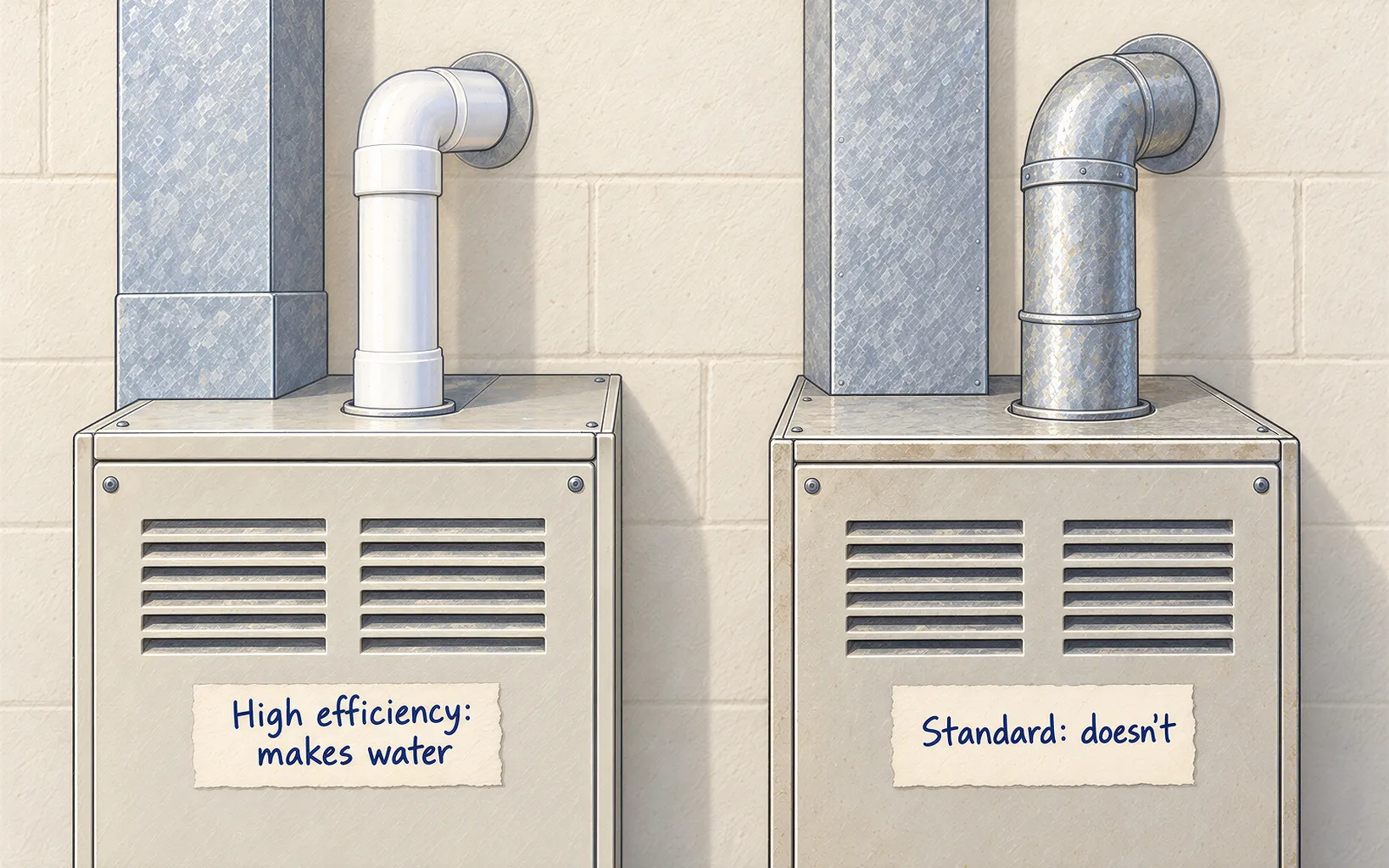
A high-efficiency furnace squeezes extra heat out of its exhaust. As the exhaust cools, the water vapor in it turns to liquid. That water, called condensate, has to drain away. Carrier says these furnaces carry efficiency ratings of 90 to 98 percent [1].
A standard furnace, rated around 80 percent, sends its exhaust up the flue hot. It generally doesn't make condensate [1].
You can usually tell which you have by the vent pipe. A white plastic pipe leaving the furnace is the mark of a high-efficiency model. A metal flue means a standard one.
Why does it matter? Because it tells you where to look. Some water draining from a high-efficiency furnace is normal. Water pooling on the floor is not [1]. And if a standard furnace is sitting in a puddle, the furnace itself probably isn't the source. Check the humidifier attached to it, the water line that feeds the humidifier, and the air conditioner's drain if the cooling has been running.
What should I do first?
Carrier's guidance comes down to four steps [1].
Turn the furnace off if water is reaching electrical parts or you can't tell where it's coming from.
Contain the water. Use a bucket or towels to protect the floor.
Look at what you can see. Check the humidifier connection for drips. Follow the drain line and look for a blockage. Look for a crack in the drain pan.
Stop there. Don't open the furnace, and don't attempt anything involving gas, electrical parts or the heat exchanger.
Call a technician if the drain or pump looks blocked or damaged, if a water line or humidifier is leaking, or if the leak continues after the basic checks [1]. Gurgling sounds, a musty smell or damp patches around the furnace are also reasons to call [1].
When is a leak the end of the line?
When the heat exchanger is involved.
The heat exchanger is the metal chamber that keeps the furnace's exhaust apart from the air you breathe. Carrier describes a breach in it as the most serious cause of a leak, because a crack can also let carbon monoxide into the air moving through your home [1].
Water and heat exchangers are linked. A crack or corrosion can let water out [1].
So treat rust as a warning. If you see corrosion inside or around the furnace along with the water, have it inspected before you run it again [1].
If the diagnosis is a damaged heat exchanger, the part costs $1,000 to $3,000 to replace [3]. On a furnace over 15 years old, that money is usually better put toward a new system. We walk through the decision in cracked heat exchanger: repair or replace?
What a leak doesn't tell you
Most leaks say nothing about the health of the furnace. A clogged drain is a maintenance item. Clearing the condensate drain is part of a standard tune up [4], which is one more reason to have one each fall. See furnace tune up cost.
A leak that keeps returning is a different matter. Ask the technician why. Ask whether the way the drain line is routed is part of the cause.
For everything else that can go wrong, start with heater not working: what to check. To judge any repair quote that follows, see furnace repair cost.
A disclosure, as always. Zero Homes doesn't repair furnaces we didn't install. We replace aging systems and service the ones we put in.
Frequently asked questions
Sources
Carrier, "Furnace leaking water: causes, signs, and solutions." https://www.carrier.com/us/en/residential/hvac-resources/furnaces/furnace-leaking-water/
Angi, "How much does the average furnace repair cost?" by Paige Bennett, updated August 23, 2024. https://www.angi.com/articles/how-much-does-common-furnace-repair-cost.htm
HomeGuide, "Furnace repair cost." https://homeguide.com/costs/furnace-repair-service-cost
HomeGuide, "How much does a furnace tune-up and inspection cost?" https://homeguide.com/costs/furnace-inspection-cost
Carrier, "Heater not working? Try our furnace troubleshooting guide." https://www.carrier.com/us/en/residential/hvac-resources/furnaces/troubleshooting-a-furnace/
Carrier, "Your guide to a furnace not turning on." https://www.carrier.com/us/en/residential/hvac-resources/furnaces/furnace-not-turning-on/
If the leak turns out to be the heat exchanger on an older furnace, it's worth seeing what replacing the system would involve. [See what furnace replacement looks like with Zero Homes](/services/furnace-replacement).