
Guide
What size heat pump do I need? Sizing for a Colorado winter

Grant Gunnison
Founder & CEO, Zero Homes
10 minute read
10/27/2026
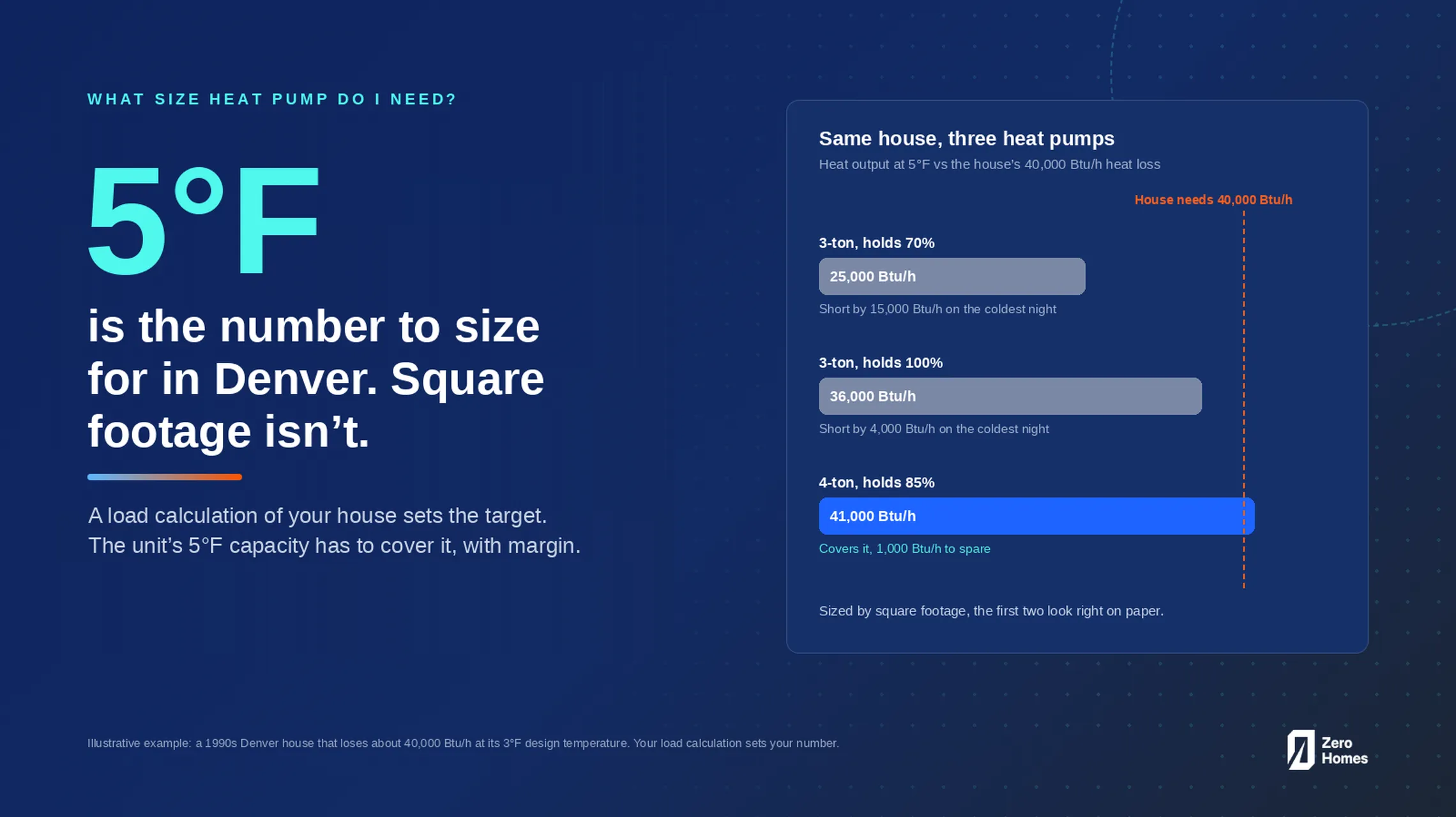
What size heat pump do you need? The one whose heating capacity at your county's design temperature covers your house's heat loss at that temperature, with a modest margin. Along the Front Range that design temperature is 0°F to 7°F, and the number comes from a Manual J load calculation (the room-by-room heat-loss method), not from square footage. Two 2,000 square foot homes in Denver can need anywhere from about 2.5 tons to more than 4 tons of heating capacity, depending on age, insulation, windows, and air leaks.
That's why a heat pump size calculator or a square-foot rule is a fine first guess and a poor final answer. In Colorado the question that matters is the one most homeowners ask us first: will it keep up on the coldest night? Heat pump sizing is how that question gets answered before anything is installed.
Key takeaways
Size a heat pump to heating, not cooling. In Denver the winter heat loss is usually larger than the summer cooling load, so matching your old AC's tonnage often comes up short.
Use the design temperature: 3°F in Denver and Fort Collins, 0°F in Boulder, 7°F in Colorado Springs. Mountain counties run -10°F to -20°F.
Read capacity at 5°F, not the nameplate. A "3-ton" cold-climate heat pump delivers 70% to 100% of its rated output at 5°F depending on the model.
Bigger isn't better. An oversized unit short-cycles and leaves summer air clammy; an undersized one leans on backup heat. Both cost you.
A good quote shows its work: your heat loss in Btu per hour, the design temperature used, and the unit's capacity at that temperature.
A right-sized heat pump also wins the year on running cost: about $750 to heat and cool a typical Denver home on Xcel's time-of-use rate, against about $880 for a 15-to-20-year-old furnace and air conditioner, about 15% less.
Why does square footage get heat pump size wrong?
The common rule of thumb is about one ton of capacity (12,000 Btu per hour) for every 500 to 600 square feet. It's quick, and it's what most online sizing charts and calculators start from. The trouble is that it gives every house of the same size the same answer, and houses of the same size lose heat at very different rates.
Here's one floor plan, a 2,000 square foot two-story in Denver, built three ways. The rule of thumb says about 40,000 Btu per hour for all three.
| Same 2,000 sq ft house | Heat loss at 3°F | Rule of thumb is |
|---|---|---|
| 2015 build, tight | About 30,000 Btu/h | A third too big |
| 1990s, average | About 40,000 Btu/h | About right |
| 1970s, original windows | About 55,000 Btu/h | A quarter short |
Illustrative heat-loss figures; your number comes from a load calculation of your house.
The square-foot rule is right for one of the three. A Manual J load calculation, published by the Air Conditioning Contractors of America as the ANSI-recognized residential load standard, gets all three right because it works from what actually drives heat loss: wall and attic insulation, window type and area, air leakage, foundation, orientation, and the local design temperature. It works room by room, which is also what tells you whether the back bedroom over the garage will be as comfortable as the living room.
One more Colorado-specific trap: sizing to the old air conditioner. If your current AC is 2.5 tons, a 2.5-ton heat pump looks like a like-for-like swap. But that AC was only ever asked to cool. Along the Front Range the heating load at design temperature is usually the larger of the two, so a heat pump matched to the old AC often comes up short in January.
Will a heat pump keep up on the coldest night? Size it to the design temperature
Yes, when it's sized to the right temperature. The design temperature is the outdoor temperature your area stays at or above for 99% of the hours in a year. It's the number a load calculation designs to, so the system holds your thermostat setting through all but a few dozen hours a winter and keeps heating, at reduced output, through those.
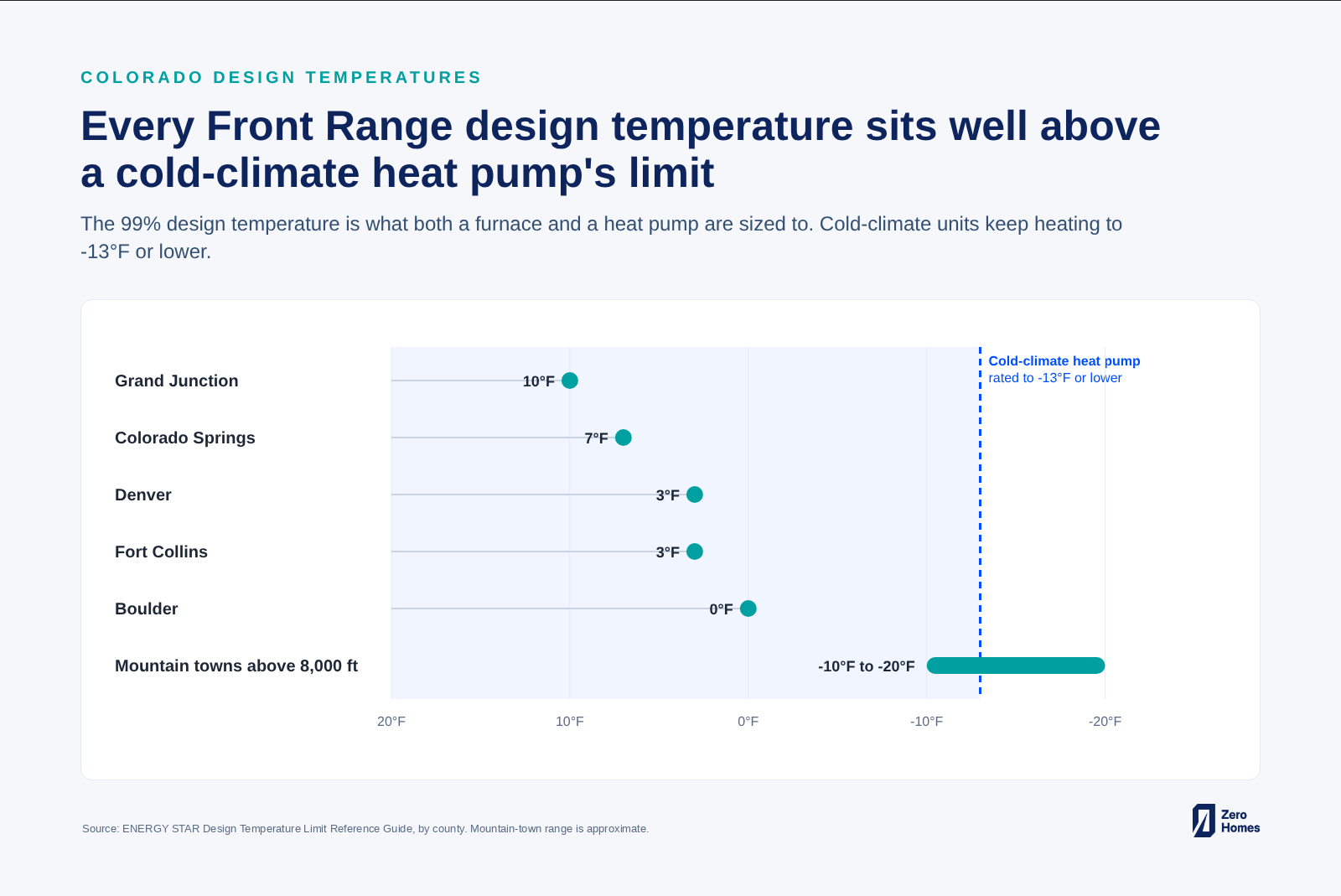
Source: ENERGY STAR design temperature reference.
The second half of sizing is reading the right capacity number. A heat pump's tonnage is rated at 47°F. As the air gets colder, output drops, and how much it drops is what separates cold-climate equipment from the rest. The PNNL cold climate heat pump sizing guide makes the same point: select from the manufacturer's extended performance data at the design temperature, not the nameplate.
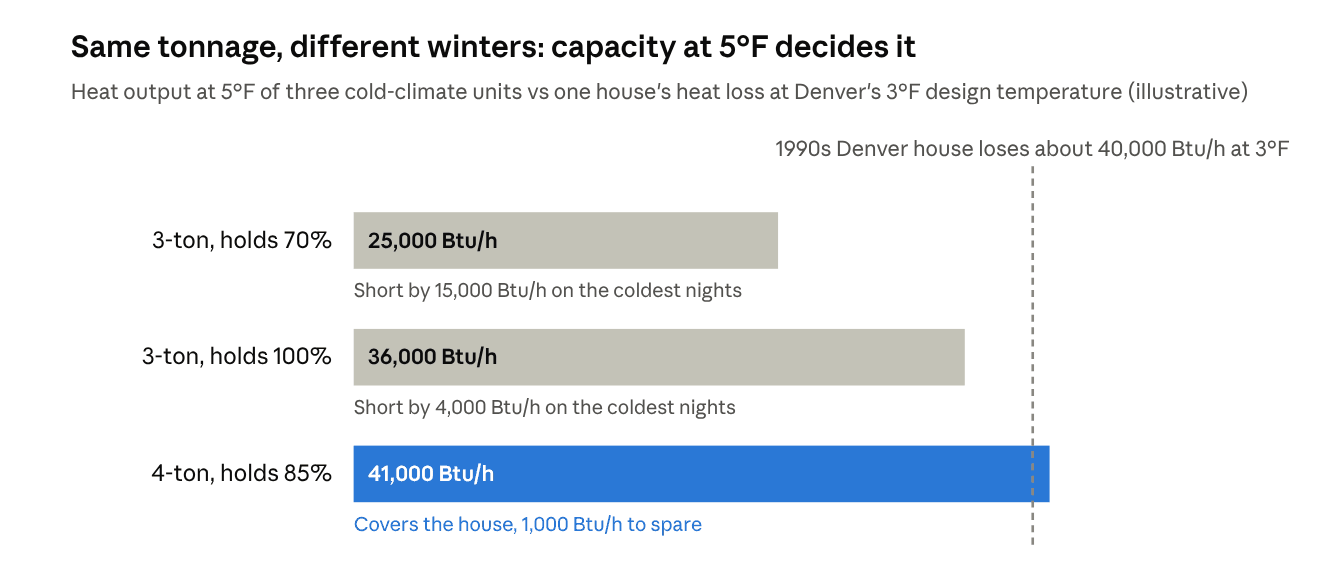
Illustrative: unit outputs at 5°F from the 70%, 100% and 85% capacity-retention examples; house heat loss from the 1990s example above.
For the 1990s house above, which loses about 40,000 Btu per hour at 3°F, the first unit falls well short, the second comes close but still falls short, and only the third covers it. Same tonnage on the first two quotes; very different winters. Why output and efficiency fall in the cold is covered in heat pump COP by temperature, and what earns a unit the cold-climate label is in what qualifies as a cold climate heat pump.
From our design desk, this is the whole job. Our engineers run a Manual J from a scan of your house, pick equipment whose capacity at your county's design temperature covers the load, and put that capacity line on the quote so you can see the margin. The cold-climate lines we install (Mitsubishi Hyper-Heat, Bosch, Daikin cold-climate, Carrier Greenspeed) hold 70% to 100% of rated capacity at 5°F, which is exactly the range in the chart. When a homeowner tells us their last heat pump "couldn't keep up," this is almost always why: a standard unit, or a cold-climate unit sized by square footage or by the old AC. The field data on correctly sized units is in do heat pumps work in cold weather?
Above about 8,000 feet, where design temperatures run -10°F to -20°F, sizing a heat pump to carry every hour alone can mean a much larger unit. For those homes a dual-fuel setup that keeps a furnace for the coldest stretches, or a sized backup heater, is often the better design, and it's one we'll recommend on the first call.
Is a bigger heat pump better? What a wrong size costs you
No. It's tempting to size up for insurance, and a little margin is good design. A lot of margin costs you in ways that show up for the life of the system.
| Sizing miss | What you'd notice | What it costs |
|---|---|---|
| Oversized | Short run cycles, clammy summer air | Higher price, more wear |
| Undersized | Cold rooms on the coldest nights | Backup heat at COP 1.0 |
An oversized unit reaches setpoint fast and shuts off, so in summer it doesn't run long enough to pull humidity out of the air, and in winter rooms swing warm and cool. Variable-speed compressors soften this by turning down, but every model has a minimum output, and a unit that's far too big spends mild days cycling below it. You also paid for capacity you don't use.
An undersized unit runs flat out on cold nights and hands the shortfall to electric resistance backup, which delivers one unit of heat per unit of electricity instead of two to four. That shows up first as a cold back bedroom and then as a January bill. Where the backup is a gas furnace in a dual-fuel setup, it shows up as more gas burned than planned.
One more piece people miss: ducts. A heat pump moves more air at a lower supply temperature than a furnace does, so ductwork that was fine for a furnace's short, hot blasts can be too small for a heat pump's longer, gentler runs. A load calculation tells you how much heat each room needs; a duct check tells you whether the existing ducts can deliver it.
Will a right-sized heat pump cost less to run than my furnace and AC?
Yes, over a full year. A right-sized cold-climate heat pump replaces two systems, the furnace in winter and the air conditioner in summer, and it spends most of the year in its efficient range. On Xcel Energy's default time-of-use rate, a typical Denver home spends about $750 a year to heat and cool with one, against about $880 for a 15-to-20-year-old furnace and air conditioner. That's about $130 a year back, about 15%.
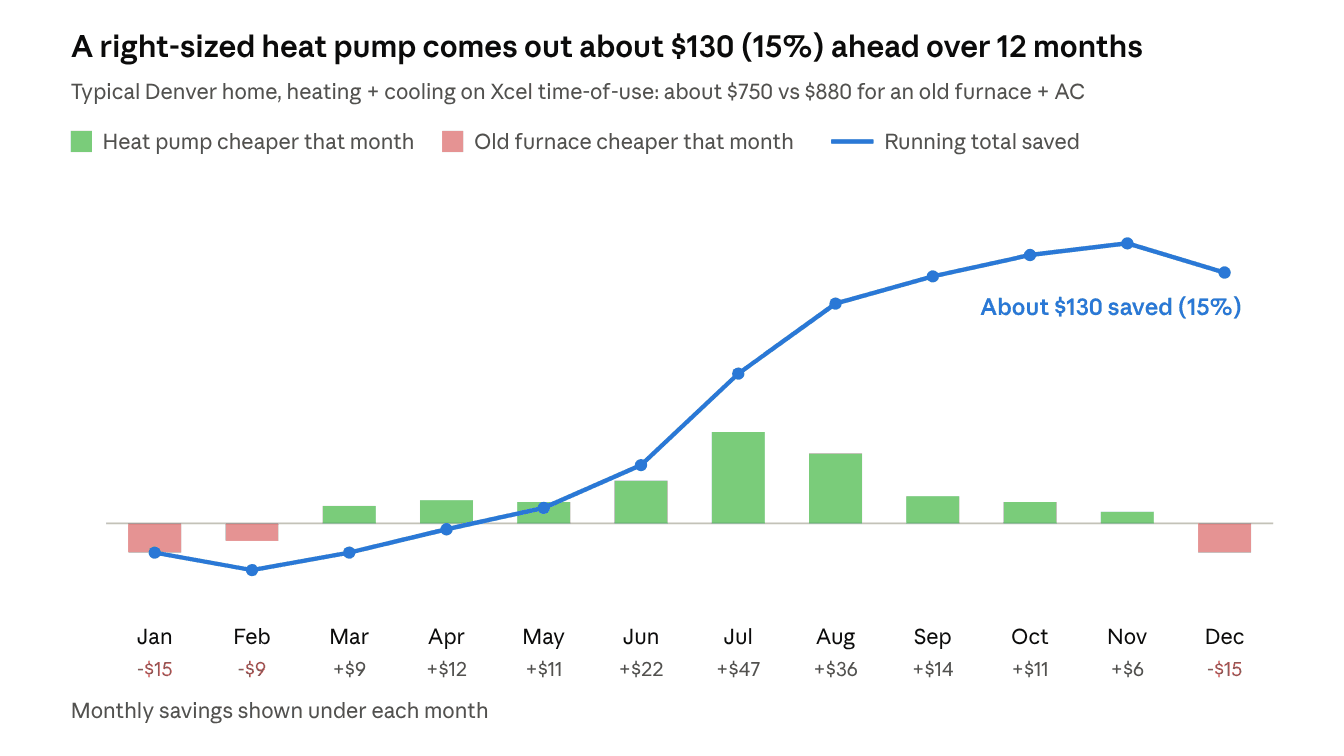
Zero Homes model: Denver normal monthly temperatures, Xcel time-of-use electricity and $0.95/therm gas, a right-sized cold-climate heat pump vs an old furnace at 72% delivered and old AC at SEER 8.5.
The savings come in all year. Spring, summer and fall do the work: a modern heat pump cools on about half the electricity of a 15-year-old air conditioner, and at 40°F to 60°F it delivers 3.5 to 4.4 units of heat per kWh. In December through February an old furnace costs a little less to run, and the other nine months pay that back four times over. That math assumes the unit is sized to the house; an undersized one gives some of it back to resistance strips on cold nights. For mountain homes, a dual-fuel setup that keeps a good furnace for the coldest weeks trims the bill further. The month-by-month comparison, including other rate plans, is in heat pump vs furnace.
How do I know my heat pump quote was sized right?
The best-value quote isn't the one with the lowest number on it; it's the one sized to your house, because that's what decides comfort and operating cost for the next 15 years. Ask for these five lines, and treat a quote that can't show them as a guess:
Your heat loss at design temperature, in Btu per hour, from a Manual J. Room by room is better.
The design temperature used. It should match your county, not a generic number.
The unit's capacity at that temperature, from the manufacturer's extended performance data, and the margin over your heat loss.
The backup plan, if any: resistance strips, a dual-fuel furnace, or none, and at what temperature it engages.
A duct check, and what changes (if any) the ducts need to deliver each room's share.
Our checklist for comparing installers on everything else, from commissioning to warranty registration, is in how to choose a heat pump installer.
We built our process around those five lines. You scan your house with our app, our engineers run the Manual J and select the equipment, and the quote, with the heat loss and capacity lines on it, comes back within 24 hours. No sales visit required to get there.
What a load calculation won't do
Be better than its inputs. A Manual J built on guessed insulation levels or a default air-leakage number is a square-foot rule with extra steps. Ask what the inputs were based on.
Predict your bill. It sizes the system for the coldest hours. Annual cost depends on the whole year's weather, your rates, and your thermostat habits.
Make a mountain home simple. At -20°F design temperatures, the right answer is often a heat pump plus backup heat, and the sizing question becomes how to split the load between them.
Frequently asked questions
Every room comfortable. Finally. If you want to know what size heat pump your house actually needs, scan it with our app and our engineers will run the load calculation and show you the capacity at your design temperature on the quote, no sales visit required. See how a cold-climate heat pump install works.