
Guide
Does a new furnace or heat pump need electrical work?

Rich Jagisch
Director of Growth
7 minute read
11/17/2026
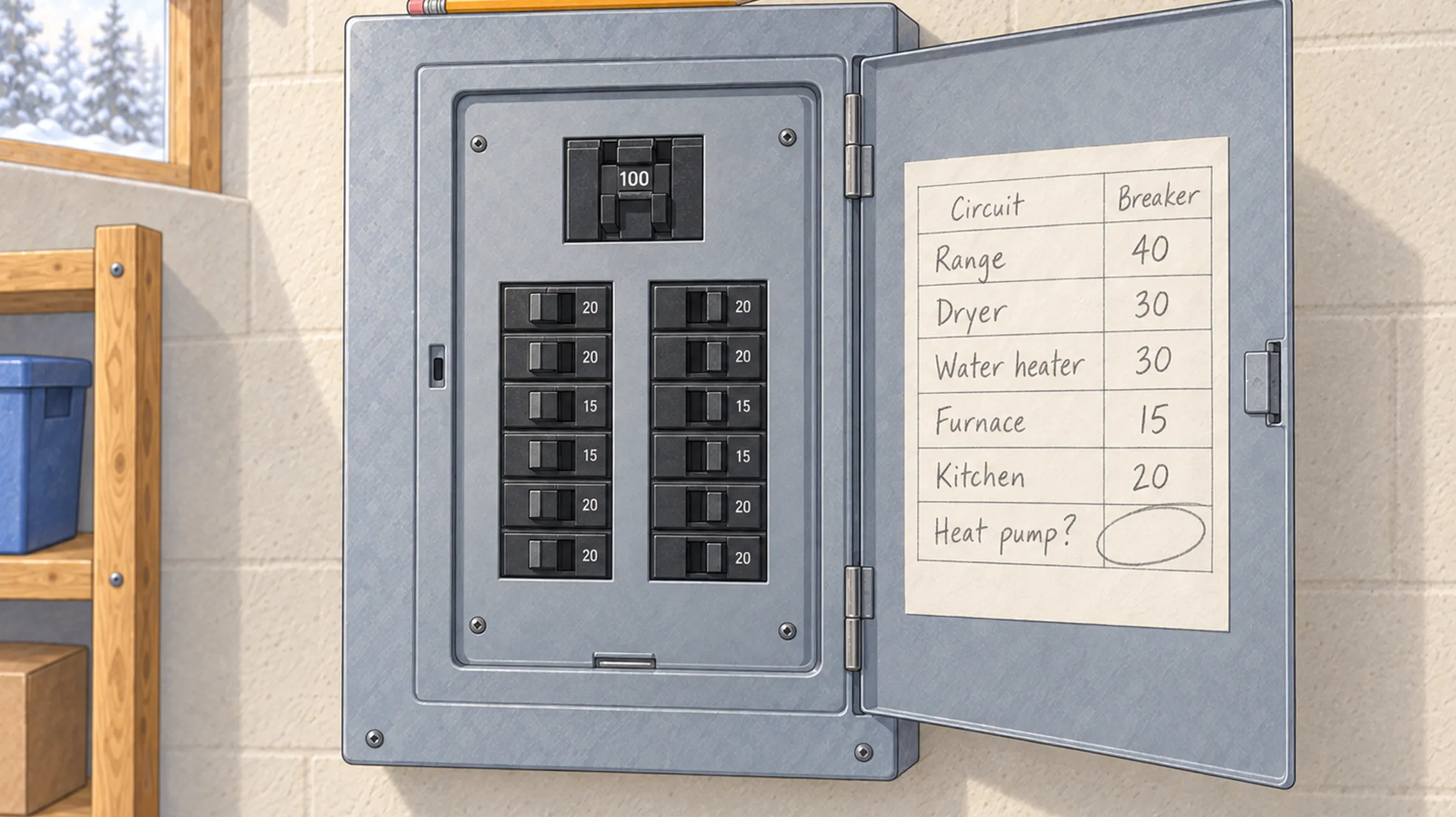
A gas furnace usually doesn't. A heat pump sometimes does. A furnace runs its fan and controls on a standard household circuit of 15 or 20 amps [1]. A heat pump needs a larger one, with a breaker of 20 to 60 amps depending on its size [2]. Whether that means new work depends on what the house already has.
That matters when you compare quotes. When electrical work is needed, it has a real price. It's also one of the lines most often left off a low bid.
Here is what the electrical involves, what it costs, and how to tell whether it's in the quote you're holding.
Key takeaways
A gas furnace typically runs on a dedicated 15- or 20-amp circuit at 120 volts. A like-for-like furnace swap rarely needs new electrical.
A heat pump needs a bigger circuit than a furnace. Some homes already have one, from a central air conditioner. Others need a new one.
A panel upgrade is possible but not automatic. Homes with 100-amp service or less are the likeliest to need one.
Published prices run from about $570 for a new circuit to $3,000 for a panel upgrade.
If a quote for a heat pump has no electrical line, ask whether any is needed, and who pays if it is.
What electrical does a new system need?
It depends on what the system burns. A gas furnace makes its heat from gas. Electricity only runs the fan and the controls. A heat pump makes all of its heat with electricity, so it draws far more. That doesn't always mean new wiring. If the house has central air, the air conditioner's circuit can often serve the heat pump that replaces it.
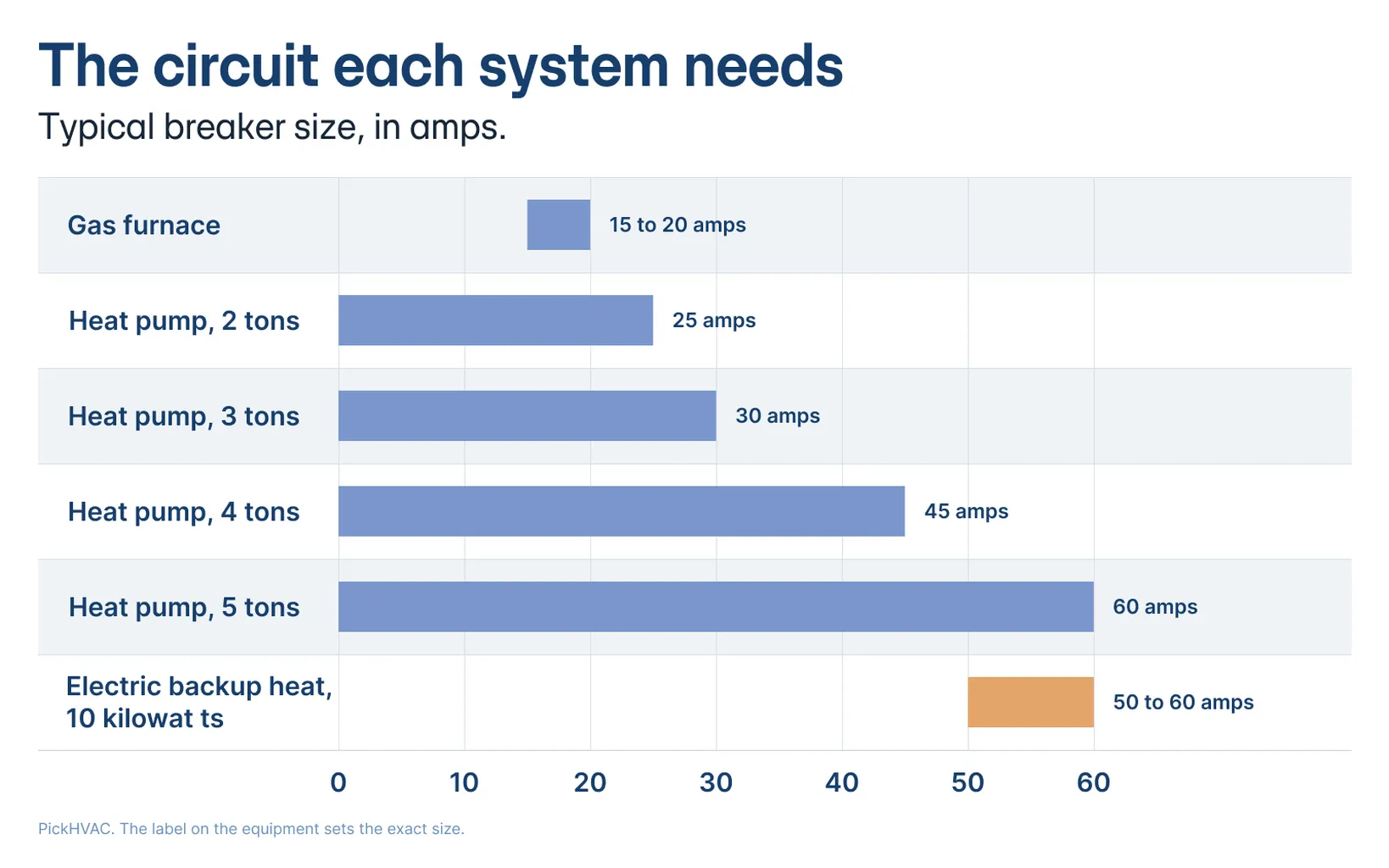
| System | What it draws | Typical breaker |
|---|---|---|
| Gas furnace | 7 to 15 amps | 15 or 20 amps |
| Heat pump, 2 tons | 10 to 15 amps | 25 amps |
| Heat pump, 3 tons | 16 to 30 amps | 30 amps |
| Heat pump, 4 tons | 25 to 30 amps | 45 amps |
| Heat pump, 5 tons | 30 to 37 amps | 60 amps |
| Electric backup heat, 10 kilowatts | About 42 amps | 50 to 60 amps |
The figures come from two guides published by PickHVAC, a national HVAC reference site [1] [2]. A ton is the industry's unit for heating and cooling capacity. These are typical values. The label on the equipment sets the exact breaker size for any given model [2].
The work usually needs a permit as well. Denver publishes its own guide to permitting a heat pump [3]. Ask your installer who pulls it.
Will my electrical panel handle a heat pump?
Often, yes. The answer depends on the size of your electrical service and what else is already on it.
New York's clean heat program publishes a useful rule of thumb [4]. Homes with less than 100-amp service, or built before 1965, are likely to need more capacity. Homes with 100-, 150- or 200-amp service might. Homes with more than 200 amps are unlikely to.
You can check your own in a minute. Open the panel door and look at the main breaker. The number on it is your service size. No label? Count the breaker spaces. Twenty spaces usually means 100 amps, 30 means 150 and 40 means 200 [4].
Look again at the last row of the table. Electric backup heat can draw more than the heat pump it supports. A 10-kilowatt backup heater pulls about 42 amps [1]. Whether a system needs backup heat, and how much, depends on the equipment and the house. We explain what changes with a cold-climate model in what makes a heat pump cold-climate.
A full panel is not the same as an overloaded one. If the service has room but the panel has no open slots, a subpanel may solve it. Devices that let two appliances share a circuit are another option [4]. A licensed electrician makes the final call.
What does the electrical cost?
| Work | Published cost |
|---|---|
| New dedicated circuit | $570 to $1,000 |
| Panel upgrade | $1,500 to $3,000 |
The circuit figure is HomeAdvisor's [5]. The panel figure comes from Inch Calculator, a national cost guide [6].
Those are averages, and your house may not be average. The price of a circuit climbs with the distance between the panel and the equipment. The price of a panel upgrade depends on the service coming into the house.
That's why the number matters. Nobody can price your electrical without knowing your panel. A quote that includes a firm figure has looked. A quote with no figure either found nothing to do or didn't look. Ask which.
Why is the electrical missing from so many quotes?
Our sales team hears a version of this often. A homeowner has two quotes for the same house. One is thousands lower. When we read them side by side, the lower one has no electrical on it.
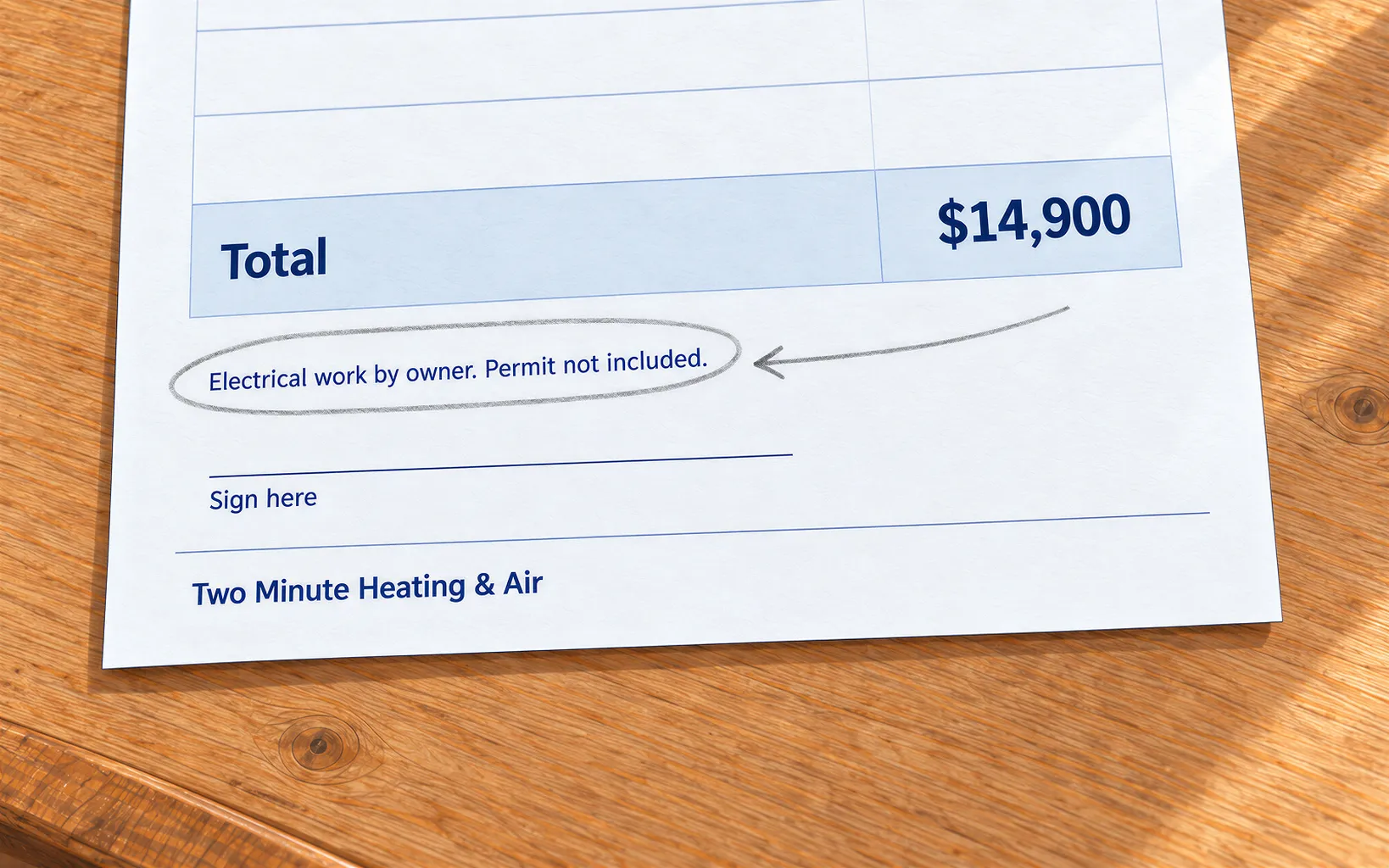
There are three ways that happens.
The estimate took two minutes. Nobody opened the panel, so nobody priced the work.
The electrical is assumed to be yours. The fine print says electrical is "by owner" or "by others." You hire the electrician, and you pay separately.
It's coming later. The work shows up as a change order once the old system is already out.
None of this means the low bidder is dishonest. It means the two totals may not be measuring the same job. Sometimes a missing line is correct, because the house needs no electrical work. The questions below tell you which. Ask these four questions before you compare them.
Is the new circuit included, and what size is it?
Has anyone looked at my panel? Does it need an upgrade or a subpanel?
Who pulls the electrical permit?
If the electrical costs more than expected, who pays the difference?
For the other lines to check, see how to compare HVAC quotes line by line.
What this means for the price
The honest version is that the electrical can make a heat pump quote higher than a furnace swap. A new furnace uses the circuit the old one used. A heat pump can sometimes use the air conditioner's circuit, and sometimes needs a new one.
That's a cost, and it belongs in the comparison. It doesn't belong in a surprise. We lay out the full-year comparison of the two systems in heat pump vs furnace.
It's also worth knowing that a panel upgrade is not a given. PickHVAC's example is a 200-amp panel with 130 amps already in use. The 70 amps left over are enough for a heat pump of any common size [2]. If a quote includes an upgrade, ask to see the load calculation behind it. That's the worksheet that adds up everything on your service.
Frequently asked questions
Sources
PickHVAC, "How many amps does a furnace use? Typical loads, breakers, and cost," by Rene Langer, September 19, 2025. https://www.pickhvac.com/?p=44935
PickHVAC, "How many amps does a heat pump use?" by Rene Langer, June 3, 2025. https://www.pickhvac.com/?p=36553
City and County of Denver, Community Planning and Development, "Permitting a heat pump." https://www.denvergov.org/Government/Agencies-Departments-Offices/Agencies-Departments-Offices-Directory/Community-Planning-and-Development/Building-Codes-Policies-and-Guides/Denver-Energy-Code/Denver-Commercial-Energy-Code/Permitting-a-Heat-Pump
New York State Clean Heat, "Assessing residential electrical service." https://cleanheatconnect.ny.gov/assessing-residential-electrical-service/
HomeAdvisor, "How much does it cost to install a dedicated circuit?" https://www.homeadvisor.com/cost/electrical/cost-to-install-a-dedicated-circuit
Inch Calculator, "Cost to upgrade an electrical panel," updated August 14, 2023. https://www.inchcalculator.com/electrical-panel-upgrade-cost-guide/
The electrical belongs in the design, not in a change order. Our engineers size the circuit when they select the equipment, and it shows up on your quote as its own line. [See how a Zero Homes quote is built](/how-it-works).