
Comparison
Heat pump vs furnace: which one makes sense for a Colorado home?

Grant Gunnison
Founder & CEO, Zero Homes
10 minute read
10/27/2026
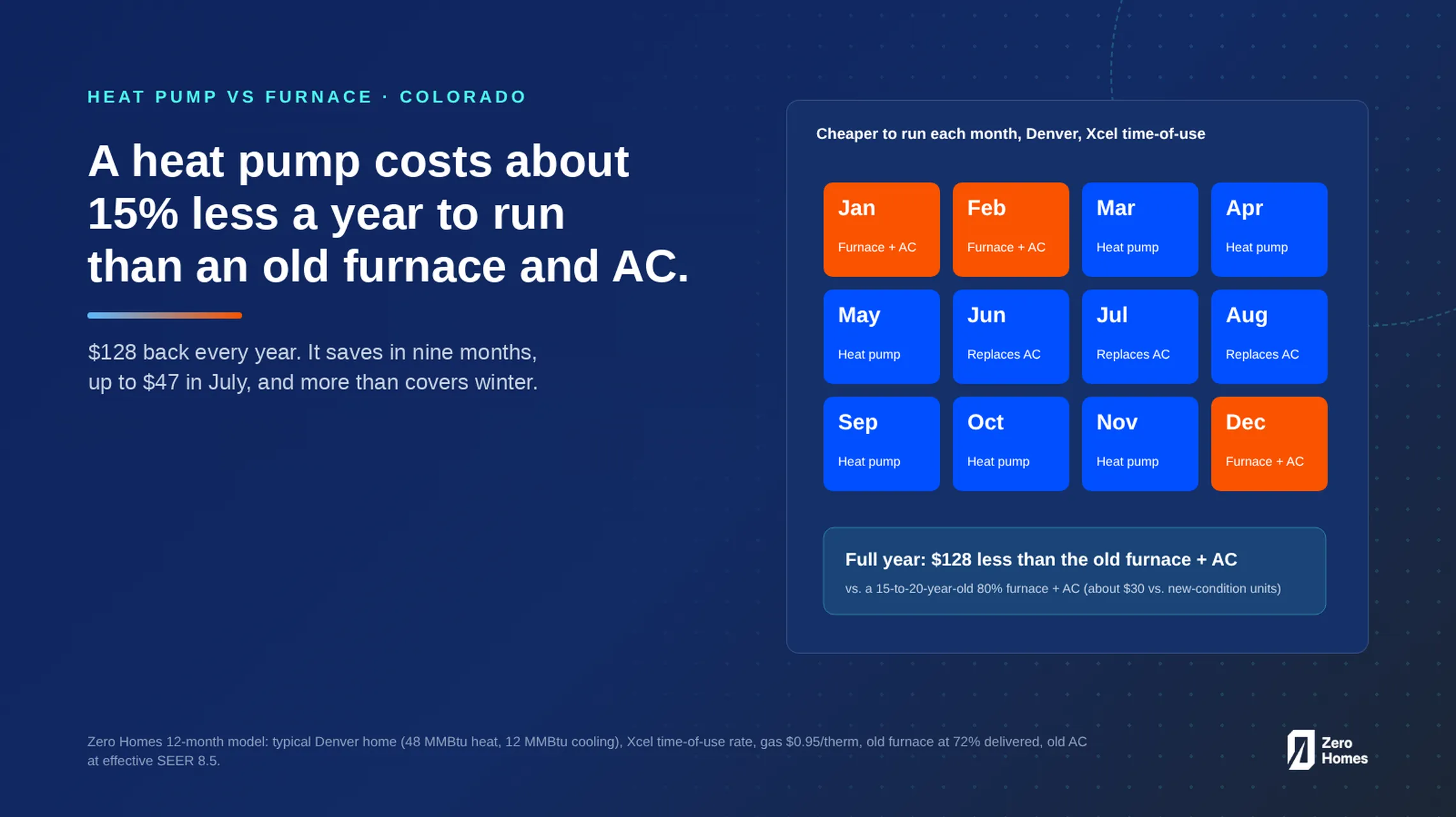
Heat pump vs furnace comes down to this for most Colorado homes with a gas furnace that's 15 or more years old: a cold-climate heat pump is the better replacement. It heats and cools with one system, keeps the house warm through a Front Range winter when it's sized to your county's design temperature, and over a full year on Xcel Energy's default rate it costs about $130 (about 15%) less to run than the old furnace and air conditioner it replaces.
Those are the two questions most homeowners bring to this decision. Will it keep my house comfortable when it's below zero? Yes, and more evenly than a furnace. Will it cost more to run than gas? Not over 12 months: the furnace is a little cheaper in December through February, and the heat pump wins the other nine months by more than enough to make up for it. If you'd rather keep a good furnace as backup, dual fuel pairs the two and runs cheaper still.
Key takeaways
A furnace makes heat by burning gas; a heat pump moves heat from outdoor air into your house, so it delivers 2 to 4 units of heat per unit of energy while a furnace tops out below 1. It also cools, so it replaces the air conditioner too.
Over 12 months in Denver on Xcel's time-of-use rate, a cold-climate heat pump comes out about $130 (about 15%) ahead of a 15-to-20-year-old furnace and AC. It comes out ahead on every rate plan and setup we modeled, from about $30 to about $330 a year (about 4% to 31%).
A cold-climate unit sized to your design temperature (3°F in Denver, 0°F in Boulder, 7°F in Colorado Springs) keeps up without gas, with long, even run cycles instead of hot blasts.
Before incentives a heat pump costs about the same as a furnace plus a new air conditioner; after Xcel and Colorado incentives it's typically less, and $0-down financing is available.
Dual fuel keeps your existing furnace for the coldest weeks and is the lowest running cost of all: about $70 a year (about 10%) below the heat pump alone with a newer 80% furnace, about $40 (5%) with a 15-to-20-year-old one.
Will a heat pump keep my house as comfortable as my furnace?
Yes, and in most homes more comfortable. A gas furnace burns gas in a heat exchanger and blows hot air through your ducts in short blasts, then shuts off until the house cools again. A heat pump is an air conditioner that runs in both directions: in winter it pulls heat out of the outdoor air (there's heat in air well below freezing) and moves it inside, running long and low at variable speed. The result is steadier temperatures room to room, and the same system cools the house in summer.
Because it moves heat rather than making it, a heat pump's efficiency, called COP (coefficient of performance), runs from about 4.0 on a 47°F day to about 2.0 at 5°F for a modern cold-climate model, against an 80% furnace's 0.80 at every temperature. The full curve, and what it means on the coldest nights, is in heat pump COP by temperature.
What decides whether it keeps up is sizing. Our engineers run a Manual J load calculation from a scan of your house in the Zero Homes app, then choose equipment whose capacity at your county's design temperature covers the heat loss with margin. You see that capacity line on the quote, within 24 hours and without a sales visit. The field data on cold-climate units running through real Colorado-style winters is in do heat pumps work in cold weather?, and how sizing works is in what size heat pump do I need?
Will a heat pump cost more to run than my furnace and AC?
No. Judge it over 12 months, because a heat pump replaces two systems. On Xcel's default time-of-use rate, a typical Denver home spends about $750 a year to heat and cool with a cold-climate heat pump, against about $880 for a 15-to-20-year-old furnace and air conditioner.
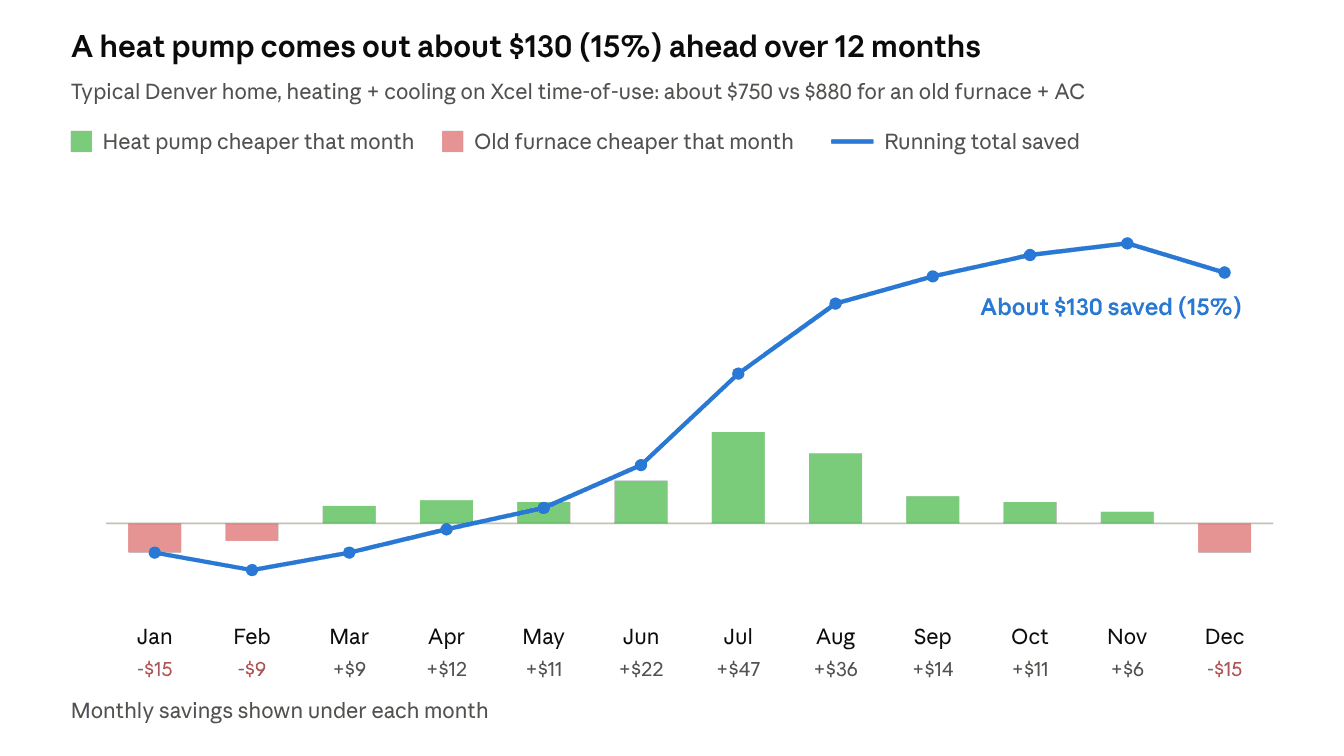
Zero Homes model: Denver normal monthly temperatures, Xcel time-of-use electricity and $0.95/therm gas, old furnace at 72% delivered and old AC at SEER 8.5.
The savings come from three places. Spring and fall are cheap months for a heat pump, because at 40°F to 60°F it delivers 3.5 to 4.4 units of heat per kWh. Summer is the biggest win: a modern heat pump cools on about half the electricity of a 15-year-old air conditioner. And only in December through February, when Denver's monthly average drops below about 36°F, does the old furnace cost a little less, $9 to $15 a month, which the other nine months pay back several times over.
Why the crossover sits at 36°F. Since late 2025, Xcel's default residential rate is time-of-use: on-peak 5 to 9 p.m. on weekdays, off-peak the other 148 hours. A heat pump heats mostly off-peak, so its blended winter price is about $0.128 per kWh with riders. Gas is about $0.95 a therm. Per unit of energy, electricity costs roughly 4x gas, so the heat pump is cheaper whenever its COP is above about 3.2, which it is whenever it's warmer than about 36°F outside.
A note on the old equipment. We don't model the furnace at its nameplate 80% or the air conditioner at its original SEER 10. A Department of Energy field study of furnaces that age measured steady-state efficiency 6.4% below the lab rating before cycling losses, so we use 72% delivered. DOE's analysis puts an older air conditioner's cycling penalty at up to 15%, so we use an effective SEER of 8.5. The heat pump carries a 10% derate on its published COP for defrost cycles and cold snaps. The home needs about 48 million Btu of heat and 12 million Btu of cooling a year, and gas stays connected for the water heater, so its $11 monthly service charge is left out of both columns.
| Month (Denver avg) | Old furnace + AC | Heat pump |
|---|---|---|
| Jan (30°F) | $117 | $132 |
| Feb (32°F) | $100 | $109 |
| Mar (41°F) | $80 | $71 |
| Apr (48°F) | $55 | $43 |
| May (58°F) | $34 | $23 |
| Jun (68°F) | $44 | $22 |
| Jul (74°F) | $93 | $46 |
| Aug (72°F) | $71 | $35 |
| Sep (64°F) | $31 | $17 |
| Oct (50°F) | $50 | $39 |
| Nov (39°F) | $84 | $78 |
| Dec (30°F) | $117 | $132 |
| 12 months | $876 | $748 |
This is also where the "gas to electric will raise my bills" worry gets its answer. Your electric bill goes up, but the total goes down. Add up what the old pair costs: about $635 a year in furnace gas plus about $240 in summer electricity for the old air conditioner, about $880. The heat pump heats and cools for about $750. That's about $130 a year back, roughly 15% of what you were spending. Month by month, the heat pump's electricity is broken out in how much electricity does a heat pump use in a Colorado winter.
Does the heat pump still win on other rate plans?
Yes. We ran the same home through every setup a Colorado homeowner is likely to choose, and the heat pump comes out ahead in all of them.
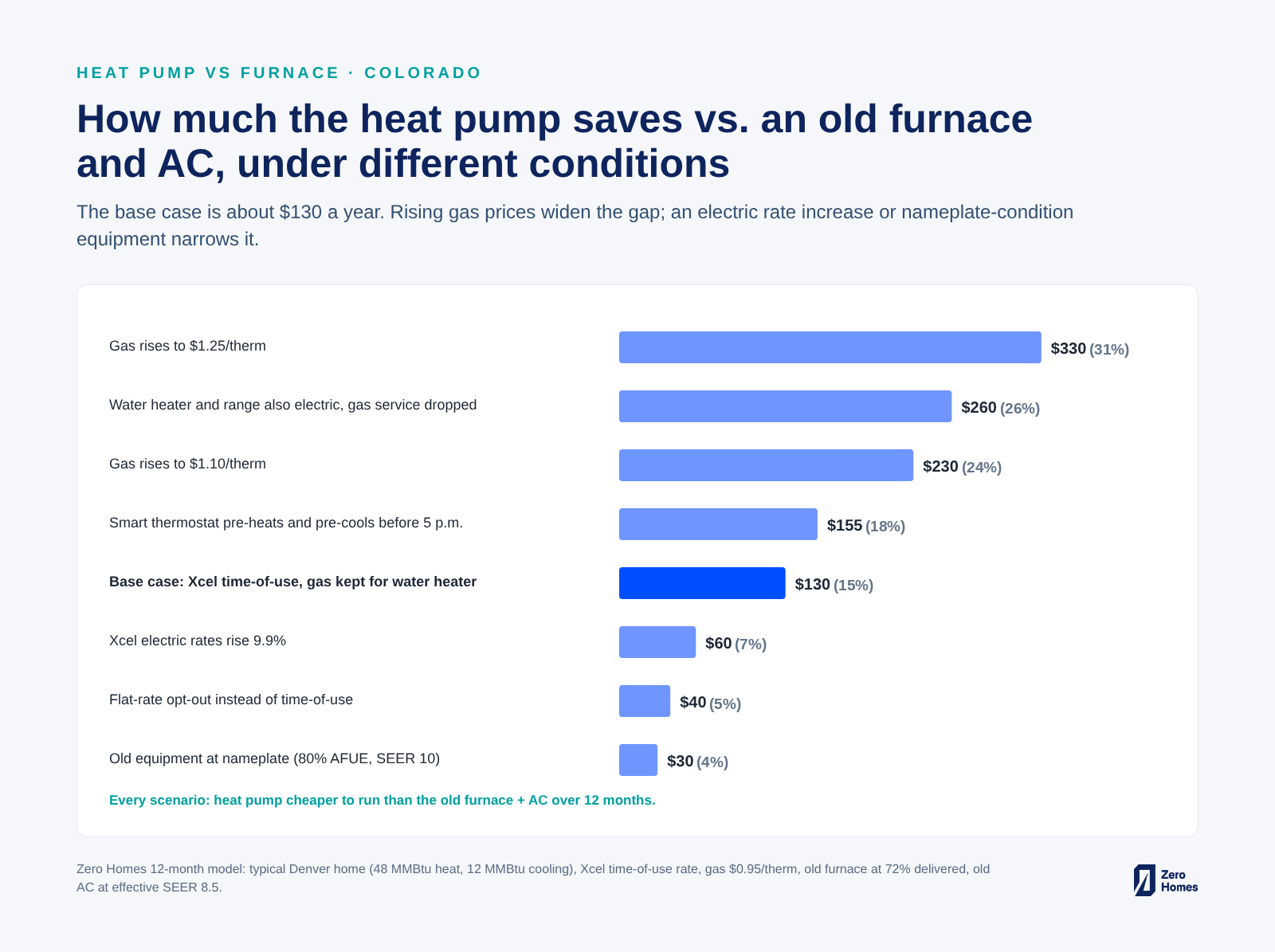
Two things move these numbers in opposite directions. Xcel has asked regulators for an 11% residential gas increase this heating season; at $1.10 a therm the heat pump's lead grows to about $230 (about 24%), at $1.25 to about $330 (about 31%). Xcel has also asked for a 9.9% electric increase, which would trim the base case to roughly $60 (about 7%). Rates on both sides move quarterly, which is why the quote runs the comparison against your actual bills.
What will a heat pump cost me upfront compared with a furnace and AC?
| Line item | Furnace + AC | Cold-climate heat pump |
|---|---|---|
| Replaces | Two systems | Both, with one |
| Xcel rebate | Small AC rebate | Tiered heat pump rebate |
| State and regional | None | $1,000 state tax credit; Power Ahead Colorado up to $1,500 in the Denver region |
| Paperwork | You | Zero Homes files it |
Before incentives, a cold-climate heat pump costs more than a furnace alone and about the same as a furnace plus a new air conditioner. After incentives, it's typically less than that pair for Front Range homes. If your air conditioner is near the end of its life too (most are, if the furnace is), furnace plus AC is the fair comparison. And you don't need the cash upfront: $0-down on-bill financing through CEF spreads the cost over your utility bill.
Price is only part of the value. A good quote shows a load calculation for your house, the unit's capacity at your design temperature, the manufacturer's warranty terms, the rebates you qualify for already netted out, and a commissioning check that the system holds temperature in heating mode. Our checklist for comparing installers on those points is in how to choose a heat pump installer.
Should I keep my furnace as backup? Dual fuel
You can. A dual-fuel system pairs a cold-climate heat pump with your existing gas furnace on one thermostat: the heat pump handles all the cooling and most of the heating, and the furnace takes over below a switchover temperature of about 36°F. Keeping the 15-to-20-year-old furnace in this model, that's about $170 a year (about 19%) ahead of the old furnace and AC, and about $40 (about 5%) ahead of the heat pump alone. With a newer 80% furnace, the edge over the heat pump alone grows to about $70 (about 10%).
It fits when the furnace is in good shape and worth keeping, when the home is in the mountains with regular -20°F nights, or when you want a gas safety net for now. A heat pump alone makes more sense when the furnace is near the end of its life, since you'd be keeping a system you're about to replace. The full comparison is in is a dual-fuel heat pump worth it in Colorado?
How do I estimate the savings for my own house?
You can rough it out in five minutes with a year of Xcel bills. Add up your winter therms and multiply by your delivered furnace efficiency (0.80 for a newer 80% furnace, about 0.72 for an old one) to get the heat your house actually uses. Multiply by 29.3 to convert to kWh of heat, then divide by a seasonal COP of about 2.9 for a cold-climate heat pump in Denver. Price those kWh at about $0.128 and compare with what you paid for gas. For cooling, take your summer kWh above your spring baseline, times your old unit's SEER divided by 17. Or skip the arithmetic: the home scan gives our engineers your actual loads, and the quote shows the running cost against your current bills.
What a heat pump won't do
Beat gas in the three coldest months. Your January electric bill will be higher than your furnace-era one; the year as a whole still favors the heat pump.
Make up for a bad sizing job, or for a standard unit. A unit sized by square footage, or a builder-grade heat pump that loses capacity below about 20°F, can fall behind on the coldest night. The numbers in this post assume cold-climate equipment sized from a load calculation.
Frequently asked questions
Every room comfortable. Finally. If you want the heat pump vs furnace answer for your house instead of a typical one, we'll design a system from a scan of your home, size it to your county's design temperature, and show you the running cost against your actual bills before anyone visits. See how it works.