
Guide
What size furnace do I need, and is mine oversized?

Rich Jagisch
Director of Growth
6 minute read
11/17/2026
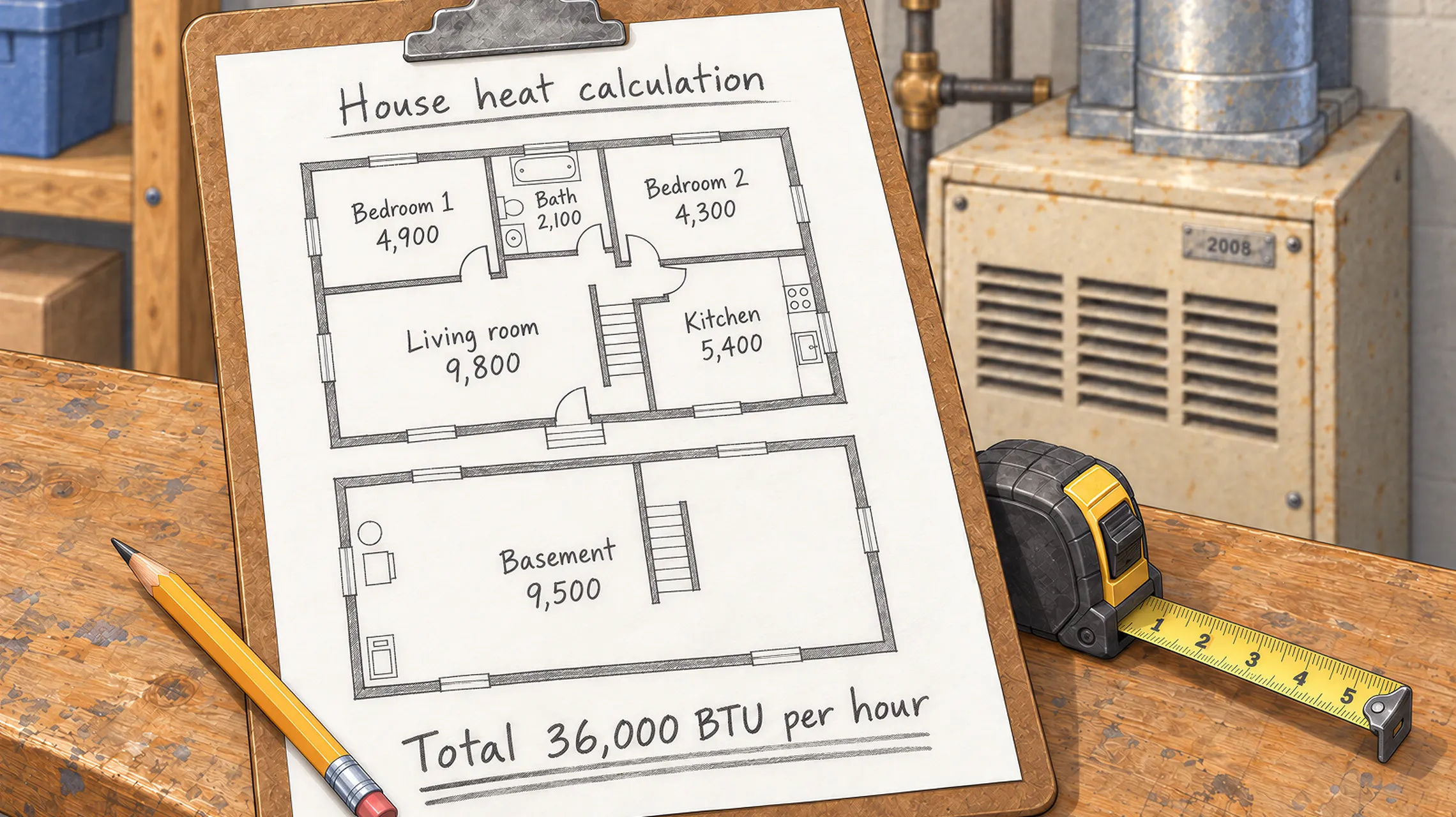
Most homes need a furnace somewhere between 40,000 and 120,000 BTU per hour [1]. A 2,000-square-foot house often lands near the middle. But square footage only gets you close. Two houses the same size can need very different furnaces.
The real answer comes from a calculation, not a chart. And bigger is not safer.
Here is how furnace sizing works, why Colorado changes the math, and how to tell if the furnace you have now is oversized.
Key takeaways
Furnace size is measured in BTU per hour. Typical homes need 40,000 to 120,000.
Size charts based on square footage are rough planning tools. The proper method is a room-by-room calculation called a Manual J.
An oversized furnace heats too fast and shuts off. That causes uneven rooms, extra wear and more repairs.
At Colorado's altitude a furnace delivers less than its rated size, so the label alone is misleading.
If your furnace runs for only a few minutes at a time, it may be too big for the house.
What size furnace do I need for my house?
A BTU is a unit of heat. A furnace's size is the number of BTUs it can produce in an hour. Carrier publishes these rough ranges [1].
| Furnace size | Approximate home size |
|---|---|
| 40,000 to 45,000 BTU | 800 to 1,500 square feet |
| 50,000 to 60,000 BTU | 1,000 to 2,000 square feet |
| 70,000 to 80,000 BTU | 1,400 to 2,500 square feet |
| 90,000 to 100,000 BTU | 1,800 to 3,000 square feet |
| 110,000 to 120,000 BTU | 2,200 to 3,500 square feet or more |
Look at how much the rows overlap. A 2,000-square-foot house could fall in any of four. Carrier itself calls these general reference ranges and says such charts are "only as rough planning tools" [1].
Why so loose? Because floor area is only one of the things that decide how much heat a house loses. Carrier lists the others: insulation, windows and doors, air leaks, ceiling height, the condition of the ductwork, which way the house faces and how cold it gets outside [1].
How is a furnace properly sized?
With a load calculation. The industry standard is called a Manual J. It's published by the Air Conditioning Contractors of America and is the recognized national standard for sizing home systems [2] [1].
A Manual J works room by room. It adds up the heat each room loses through its walls, windows, ceiling and floor on a very cold day. The total is the amount of heat the furnace has to replace. That number is the size you need.
ENERGY STAR's checklist for comparing contractor bids asks whether each one will measure your home and calculate the equipment size this way. It also asks whether you'll be given the calculation afterward [3].
That second question is the useful one. If a contractor says they did a load calculation, ask to see it.
What's wrong with an oversized furnace?
Bigger sounds safer. It isn't.
An oversized furnace heats the air around the thermostat quickly, then shuts off before the rest of the house catches up. Carrier lists the results: uneven temperatures, lower efficiency, higher maintenance costs and more wear [1].
The wear is the expensive part. The heat exchanger, the part that keeps exhaust apart from household air, takes the strain. Carrier notes that proper sizing helps reduce the stresses on a furnace [4]. A cracked heat exchanger is the costliest repair a furnace can need. We cover it in cracked heat exchanger: repair or replace?
Too small has its own problems. An undersized furnace runs without stopping and still struggles to reach the setting [1]. Oversizing often starts with a shortcut. The new furnace gets matched to the old one's label, and the old one may have been a guess too.
Why does altitude change the size?
Because a furnace burns less fuel in thin air.
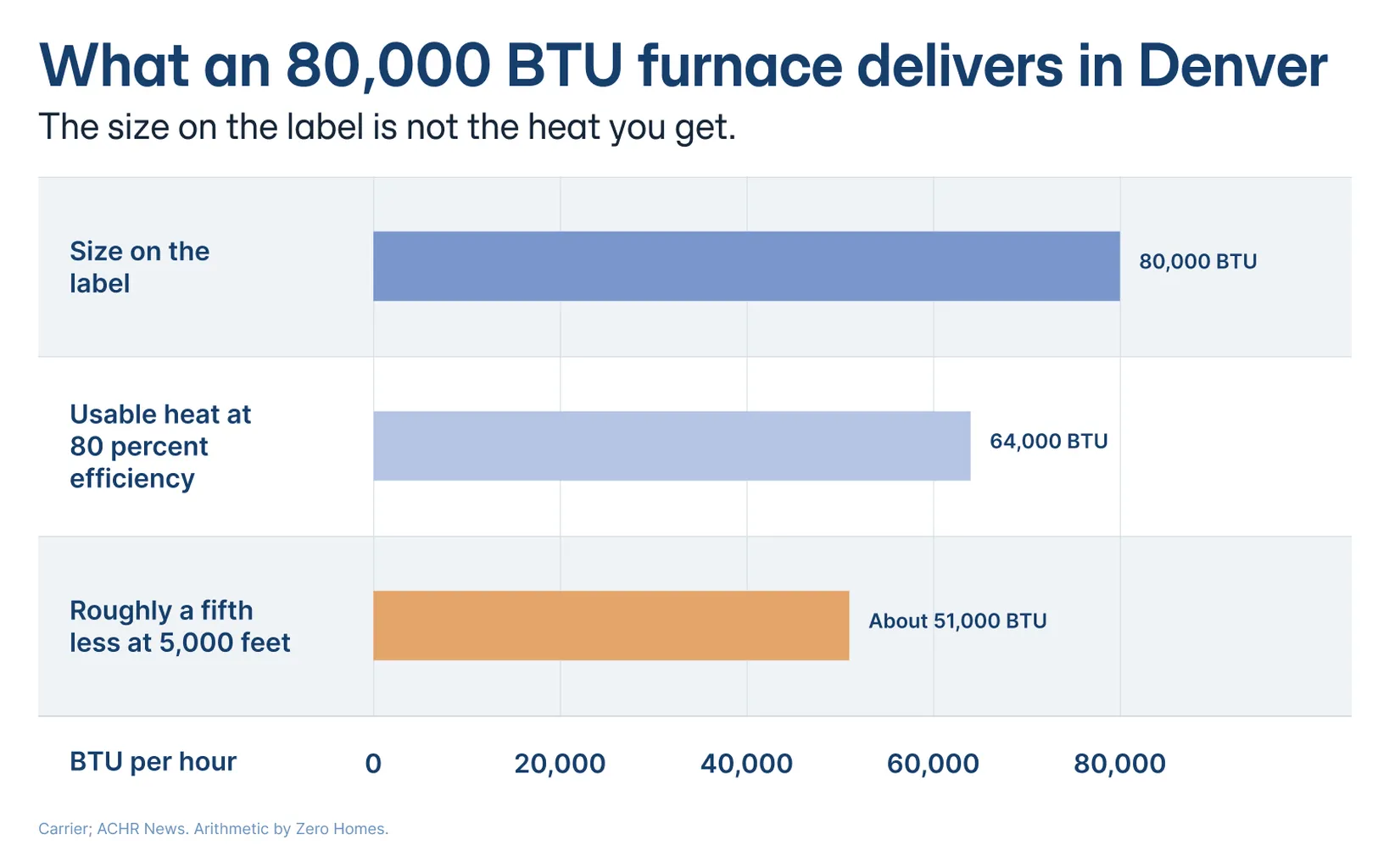
A furnace's label shows what it produces at sea level. Most models have to be adjusted downward by 4 percent for every 1,000 feet above 2,000 feet. At 5,000 feet, a furnace loses roughly a fifth of its rated output [5].
There's a second number to account for: efficiency. A standard gas furnace must turn at least 80 percent of its fuel into usable heat. High-efficiency models reach as high as 98.5 percent [1].
Put the two together for a common furnace in Denver.
| Step | Heat per hour |
|---|---|
| Size on the label | 80,000 BTU |
| Usable heat at 80 percent efficiency | 64,000 BTU |
| Roughly a fifth less at 5,000 feet | About 51,000 BTU |
So an "80,000 BTU furnace" in Denver delivers about 51,000. A contractor who sizes from a sea-level chart will get the wrong answer. One who adds a big cushion to be safe will get a different wrong answer.
Is my furnace oversized?
You can check without tools. On a cold day, time how long the furnace runs each time it comes on.
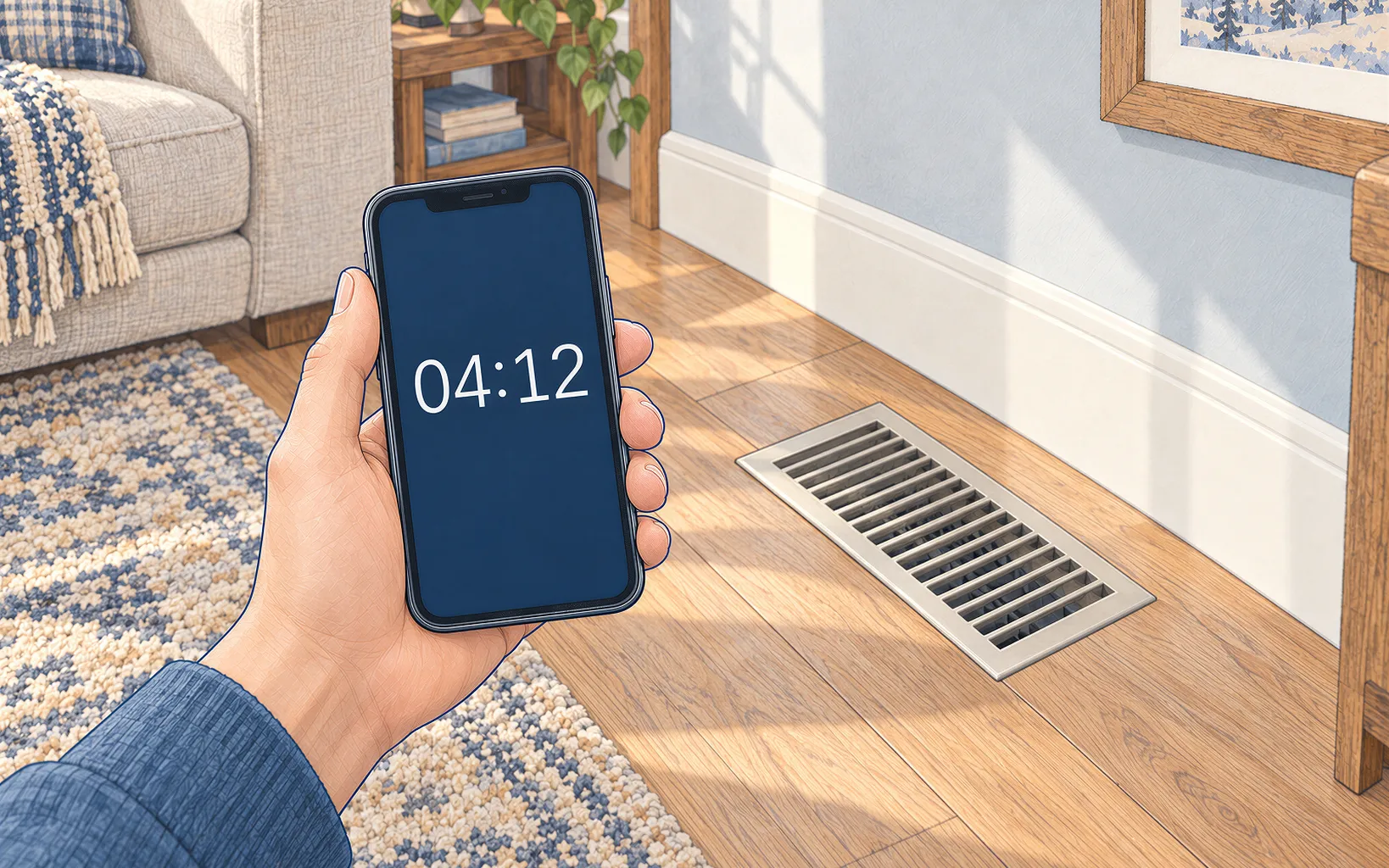
A furnace that fits the house runs for 10 to 20 minutes at a stretch, two to four times an hour [6]. A furnace that runs for only 3 to 7 minutes and then shuts off is short cycling [6].
Short runs have other causes, and some are cheap to fix. A clogged filter is the first thing to rule out. We list them in why is my furnace short cycling?
But if the filter is clean, the parts check out and the runs are still short, size is the likely cause. Other signs point the same way. Some rooms are always warmer than others. The air blasts, then stops. The house feels warm and then cool again within the hour.
No repair fixes this. The furnace is doing what it was built to do. It's simply too big.
What sizing can't tell you
A load calculation gives you the right size. It doesn't fix the ducts. If one bedroom is cold because the duct that feeds it is too small or leaks, a correctly sized furnace will still leave it cold. We explain that problem in hot upstairs, cold downstairs.
It also describes the house as it is today. Add insulation or replace the windows and the house needs less heat than before. If that work is planned, do the calculation with it in mind.
And it applies to any system, not only a furnace. A heat pump is sized from the same calculation, with one extra step for cold weather. That's in what size heat pump do I need?
Frequently asked questions
Sources
Carrier, "Calculating furnace size." https://www.carrier.com/us/en/residential/hvac-resources/furnaces/calculating-furnace-size/
Air Conditioning Contractors of America, "Manual J residential load calculation." https://www.acca.org/Manual-J
ENERGY STAR, "Heating & air conditioning installation bid comparison checklist." https://www.energystar.gov/ia/home_improvement/heat_cool/HVAC_QI_bidsheet.pdf
Carrier, "Understanding heat exchangers," reviewed September 22, 2026. https://www.carrier.com/us/en/residential/hvac-resources/heat-exchanger/
ACHR News, "Furnaces must be modified for high-altitude applications," by Joanna R. Turpin, November 27, 2017. https://www.achrnews.com/articles/136057-furnaces-must-be-modified-for-high-altitude-applications
PickHVAC, "How long should a furnace run?" by Rene Langer, September 11, 2025. https://www.pickhvac.com/?p=44822
The right size comes from your house, not from a chart. Our engineers calculate it from a scan you take with your phone, then pick equipment that covers it. [See how a Zero Homes design works](/how-it-works).