
Guide
Cold climate heat pump: what qualifies, and what to look for in Colorado

Grant Gunnison
Founder & CEO, Zero Homes
9 minute read
10/26/2026
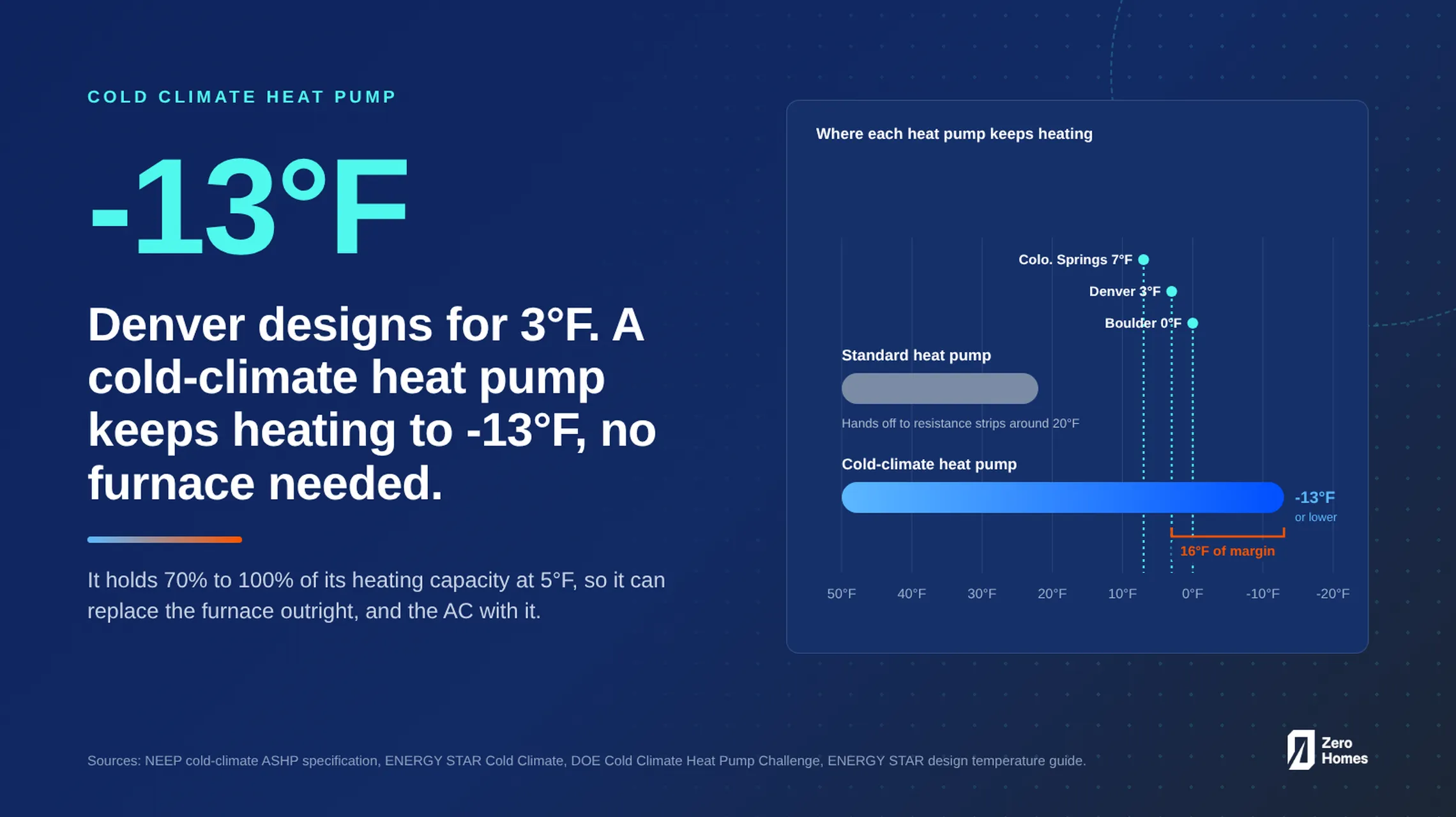
A cold climate heat pump is a heat pump certified to keep heating efficiently well below freezing: it holds at least 70% of its rated heating capacity at 5°F, delivers a COP (coefficient of performance, units of heat per unit of electricity) of at least 1.75 there, and keeps running to -13°F or lower. Along the Front Range of Colorado, where the heating design temperature is 0°F to 7°F, that's the difference between a heat pump that carries the whole winter and one that hands the job to resistance strips.
It also answers the two questions most Colorado homeowners ask first. Will it keep the house warm when it's below zero? Yes, when it's cold-climate rated and sized to your county's design temperature. Will it cost more to run than a furnace and air conditioner? No: over 12 months a typical Denver home spends about $130 (about 15%) less heating and cooling with a cold climate heat pump than with a 15-to-20-year-old furnace and AC.
Key takeaways
"Cold climate" is a certification, not a marketing term. NEEP, ENERGY STAR Cold Climate, and the DOE Cold Climate Heat Pump Challenge each set minimums at 5°F.
A cold climate heat pump delivers 2.5 times the heat of an 80% furnace per unit of energy at 5°F, and still about 1.9 times at -15°F.
Comfort comes from capacity at your design temperature: 3°F in Denver and Fort Collins, 0°F in Boulder, 7°F in Colorado Springs. A load calculation sizes for it.
Over a full year it costs about 15% less to run than an aging furnace and AC, mostly because it replaces the air conditioner too.
The best value is the whole offer: the right unit, sized from a load calculation, with rebates and $0-down financing netted out on the quote.
What is a cold climate heat pump?
A heat pump is an air conditioner that runs in both directions: it moves heat out of your house in summer and pulls heat from outdoor air into your house in winter. Air at 0°F still holds plenty of heat, but extracting it takes more compressor work the colder it gets. A standard heat pump runs short of capacity around 20°F to 25°F and leans on electric resistance strips, which are no more efficient than a space heater.
A cold climate heat pump is the same machine pushed harder in two places. The compressor is variable-speed and inverter-driven, so it ramps up to full output in the cold instead of cycling at one speed. And the refrigerant cycle uses vapor injection (Mitsubishi calls its version Hyper-Heat, Carrier calls it Greenspeed, and Bosch builds it into its cold-climate heat pumps), which keeps the compressor producing useful heat where a standard cycle collapses.
Will a cold climate heat pump keep my house warm when it's below zero?
Yes, when it's rated and sized for your county. The chart shows how much heat a typical cold climate heat pump delivers for each unit of electricity, next to an 80% gas furnace, from a mild fall day to 15 below zero.
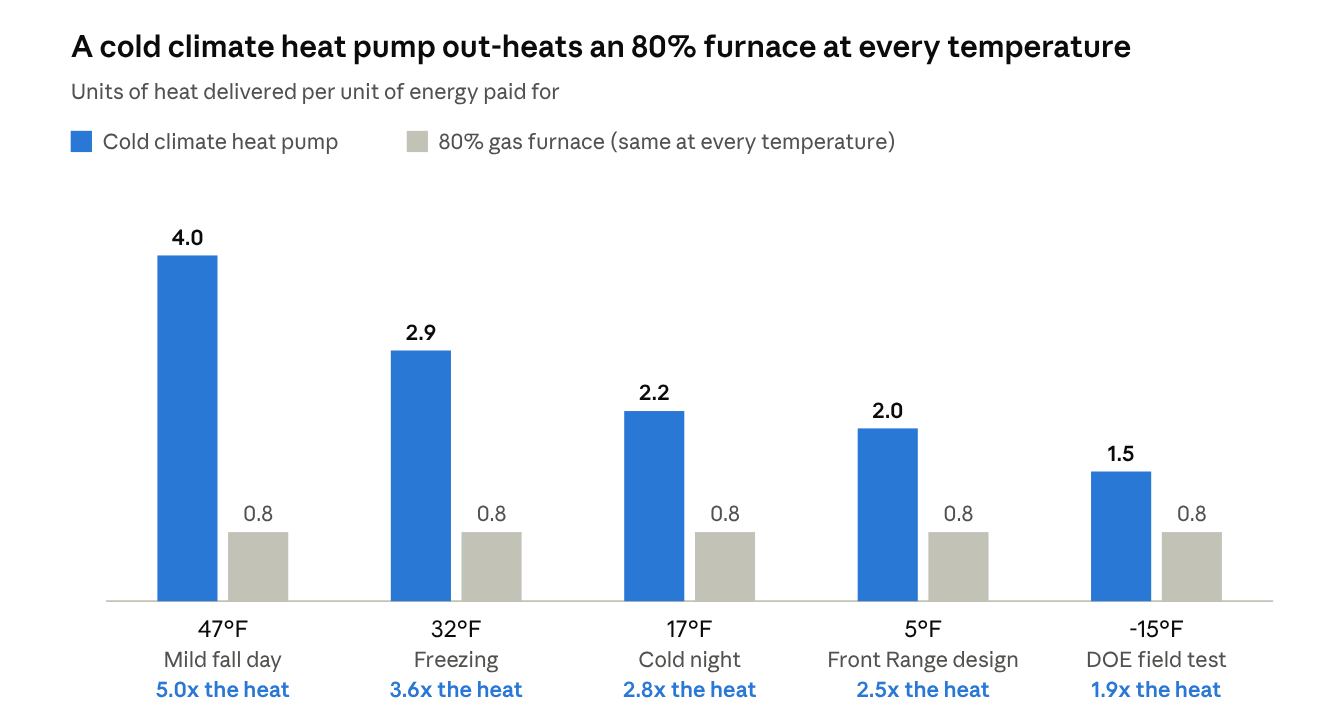
Typical cold climate heat pump COP (DOE, NEEP, manufacturer data; -15°F from the DOE field validation) vs an 80% AFUE gas furnace.
At every temperature the heat pump delivers more heat per unit of energy, and it never stops heating: in the DOE's field validation, 22 homes ran through winters down to -15°F with little help from backup heat. The full curve is in heat pump COP by temperature, and the field data in do heat pumps work in cold weather?
What keeps a house warm on the coldest night is capacity: how many Btu the unit delivers at your county's design temperature, the outdoor temperature you're at or above 99% of the hours in a year.
| Location | Design temp | What it needs |
|---|---|---|
| Denver, Fort Collins | 3°F | 70%+ capacity at 5°F |
| Boulder | 0°F | 80%+ capacity at 5°F |
| Colorado Springs | 7°F | 70%+, a little more margin |
| Grand Junction | 10°F | Cold climate preferred |
| Above 8,000 ft | -10°F to -20°F | Cold climate plus backup |
Source: ENERGY STAR Design Temperature Limit Reference Guide, by county.
That's why our engineers start with a Manual J load calculation (the room-by-room heat-loss method) from a scan of your house in the app, not a sales visit. Then they pick a unit whose 5°F capacity, from the manufacturer's extended data rather than the nameplate, covers that load with margin, and they put that capacity line on your quote. When a heat pump "doesn't keep up," the cause is almost always a standard unit where a cold climate one was needed, or a unit sized by square footage. How sizing works, and how to check a quote for it, is in what size heat pump do I need?
Will it cost more to run than my furnace and air conditioner?
No. Judge running cost over the whole year, because a cold climate heat pump replaces two systems. On Xcel Energy's default time-of-use rate, a typical Denver home spends about $750 a year to heat and cool with one, against about $880 for a 15-to-20-year-old furnace and air conditioner. That's about $130 a year back, about 15%.
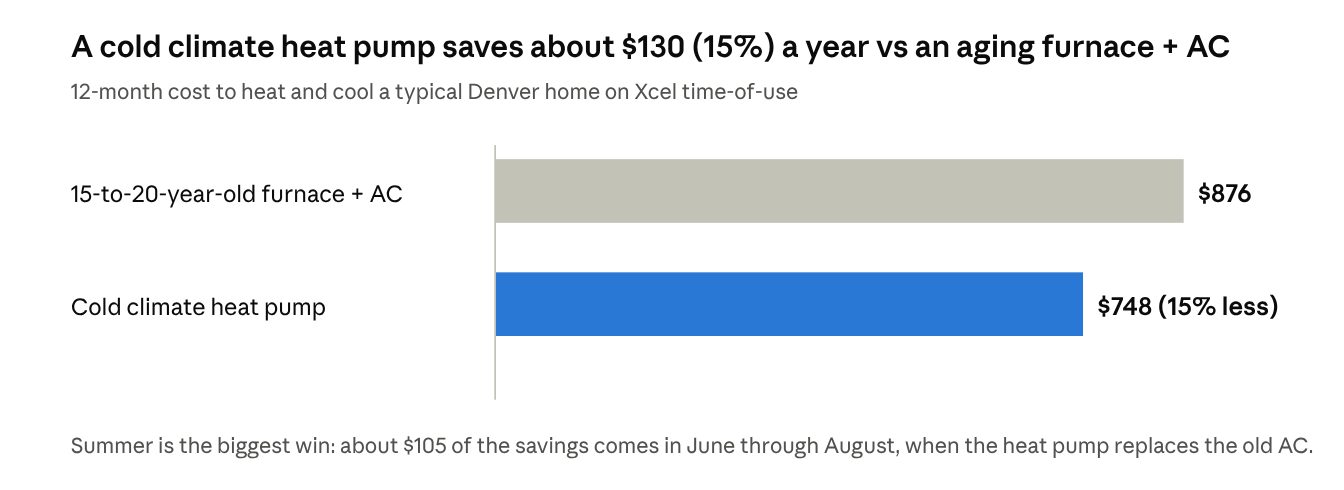
Zero Homes model: Denver normal monthly temperatures, Xcel time-of-use electricity and $0.95/therm gas, old furnace at 72% delivered and old AC at SEER 8.5.
The heat pump wins nine months of the year outright: spring and fall heating is cheap at a COP of 3.5 or more, and summer cooling takes about half the electricity of an aging AC. In December through February, when gas is cheapest relative to electricity, an old furnace costs a little less to run, and the other nine months pay that back several times over. The month-by-month math is in heat pump vs furnace, and what the winter electric bill looks like is in how much electricity a heat pump uses in a Colorado winter.
Should I keep my furnace as backup?
Along the Front Range you don't need to: a cold climate heat pump sized to the design temperature heats the house on its own. But if your furnace is in good shape, keeping it as backup in a dual-fuel setup is the lowest operating cost of all. The heat pump handles all the cooling and most of the heating, and the furnace takes the coldest weeks.
| Setup, typical Denver home | 12-month cost |
|---|---|
| 80% furnace + 15-year-old AC | About $813 |
| Cold climate heat pump alone | About $748 (about 8% less) |
| Dual fuel: heat pump + 80% furnace | About $676 (about 17% less) |
Modeled on Xcel's time-of-use rate at $0.95 a therm, with Denver's normal monthly temperatures.
Dual fuel also fits mountain homes that see -20°F nights. If your furnace is near the end of its life, a heat pump alone makes more sense than paying to keep it. The full comparison is in is a dual-fuel heat pump worth it in Colorado?
How do I know a heat pump is really cold-climate rated?
Look for one of three certifications. The thresholds overlap but aren't identical, which is why the numbers matter more than the sticker.
| Program | COP at 5°F | Capacity at 5°F |
|---|---|---|
| NEEP cold-climate spec | 1.75 or higher | Reported |
| ENERGY STAR Cold Climate | Reported | 70% or more |
| DOE Challenge | 2.1 to 2.4 | 100% |
| Program | HSPF2 | Lowest operating temp |
|---|---|---|
| NEEP cold-climate spec | Set per version | Typically -13°F or lower |
| ENERGY STAR Cold Climate | 8.1 ducted, 8.5 ductless | Reported |
| DOE Challenge | 8.5 coldest region | -15°F segment |
Sources: NEEP cold-climate ASHP specification · DOE Residential Cold Climate Heat Pump Technology Challenge · ENERGY STAR cold climate criteria.
If a quote calls a unit "cold climate" but shows no NEEP listing or ENERGY STAR Cold Climate mark, ask for the 5°F capacity and COP from the manufacturer's extended performance data. Every real cold climate model has it.
How do I get the best overall value?
The best value isn't the lowest line item; it's the system that keeps the house comfortable for the next 15 years, at a net cost you can see up front. Start with equipment built for the cold.
| Line | Heat output at 5°F | Keeps heating down to |
|---|---|---|
| Mitsubishi Hyper-Heat | 100% of rated capacity | -13°F guaranteed; some models rated to -22°F |
| Bosch | 100% of rated capacity, at a COP of 2.1 | -13°F |
| Daikin FIT Aurora | 87% to 100%, depending on size | -20°F; met the DOE Cold Climate Heat Pump Challenge |
| Carrier Infinity with Greenspeed | 100% of rated capacity; held 100% at 0°F in field trials | -13°F in DOE field trials; -23°F in lab testing |
All four are variable-speed, so they ramp up on cold nights instead of switching to backup heat. Mitsubishi Hyper-Heat comes ducted or ductless; Bosch, Daikin and Carrier are ducted systems that drop into an existing furnace and AC setup.
Sources: Mitsubishi Hyper-Heat product data · Bosch Home Comfort · Daikin FIT Aurora spec sheet · ACHR News on Carrier's DOE Challenge units. Capacity varies by model size.
Which one goes in a given house is a design decision: the load at design temperature, the ductwork, the electrical panel, and whether any room needs its own zone decide it. Then check the rest of the offer:
A load calculation for your house and the unit's capacity at your design temperature, on the quote.
The manufacturer's warranty terms, plus a commissioning check that the system holds temperature in heating mode.
Every rebate you qualify for found and filed for you. Xcel Energy's heat pump rebates are tiered toward cold-climate equipment, and the state heat pump credit and income-qualified HEAR program can also apply.
Financing that fits, including $0-down on-bill financing through CEF.
Our checklist for comparing installers is in how to choose a heat pump installer.
What a cold climate heat pump won't do
Hold its 47°F efficiency all winter. COP falls from about 4.0 to about 2.0 by 5°F. It's still 2.5 times as efficient as an 80% furnace there, but your January electric bill will be higher than October's.
Make a standard heat pump cold-climate. The rating belongs to specific models. A builder-grade unit without variable speed and vapor injection loses significant capacity below about 20°F.
Fix a bad sizing job. Below its balance point, even a great unit falls behind, which is why the load calculation comes first.
Frequently asked questions
Every room comfortable. Finally. If you want to know whether a cold climate heat pump sized to your county's design temperature would keep up in your house, our engineers will design one from a scan of your home and show you the capacity line on the quote, no sales visit required. See how cold climate heat pump installation works.