
Guide
Heat pump COP by temperature: what the efficiency numbers actually mean

Grant Gunnison
Founder & CEO, Zero Homes
9 minute read
10/27/2026
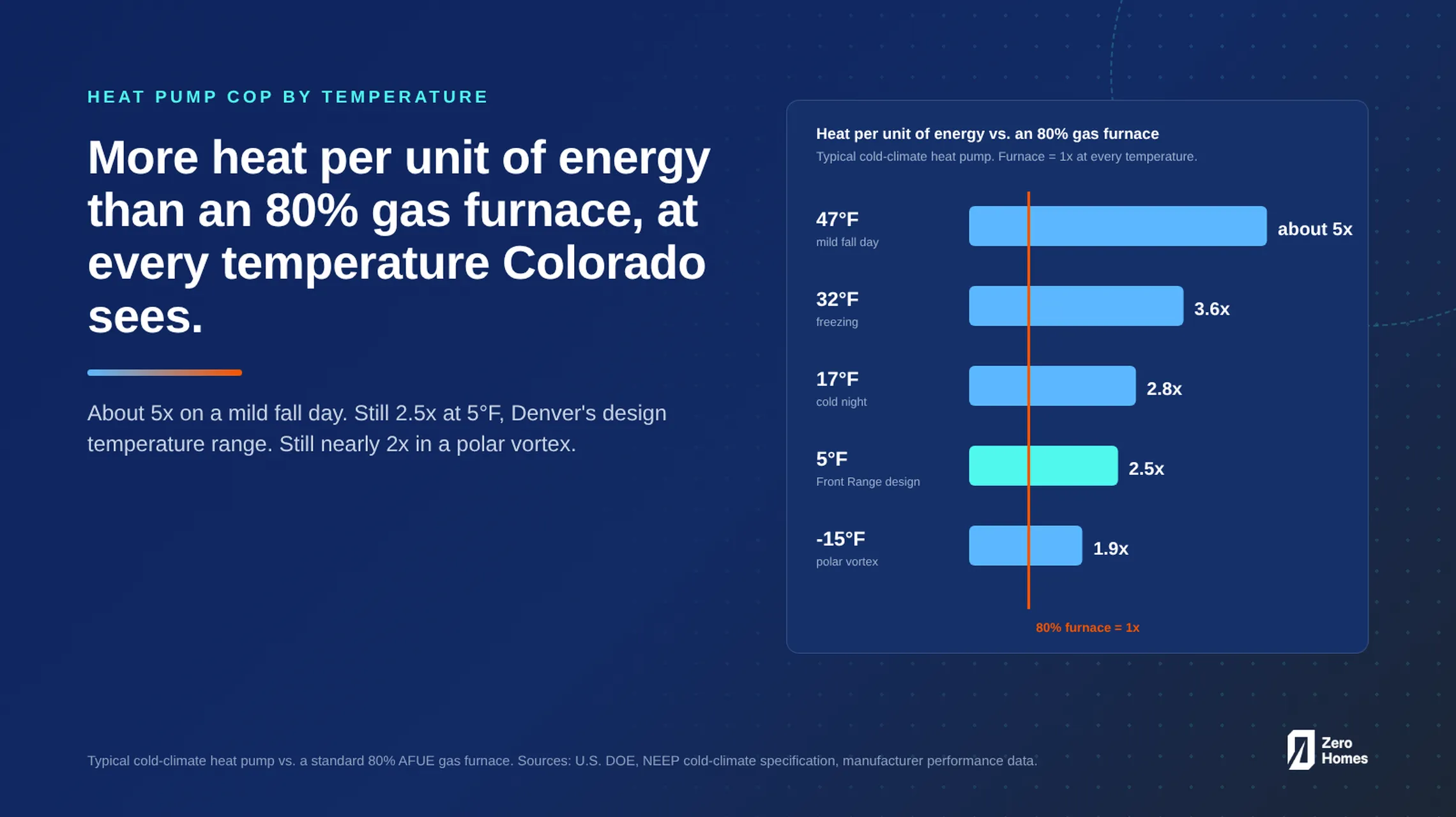
Heat pump COP (coefficient of performance) is how many units of heat you get for each unit of energy you pay for. A modern cold-climate heat pump runs at about 4.0 on a 47°F day and about 2.0 at 5°F. The 80% gas furnace in most Colorado basements sits at 0.80 at every temperature, so even on the coldest night the heat pump delivers about two and a half times the heat per unit of energy.
That leads to the two questions most Colorado homeowners actually ask about heat pump COP. Will it keep the house warm when it's below zero? Yes, when the unit is cold-climate rated and sized to your county's design temperature, which is 0°F to 7°F along the Front Range. Will it cost more to run than gas? Not over a full year on Xcel's rates: a typical Denver home runs about $130 a year cheaper (about 15%) than with a 15-to-20-year-old furnace and air conditioner, and about $65 (8%) cheaper than with an 80% furnace in good shape, and a dual-fuel setup that keeps a good furnace for the coldest weeks trims about $70 more (about 10%).
Key takeaways
COP is heat delivered divided by energy used. A COP of 3.0 means 300% efficiency. An 80% furnace is a COP of 0.80.
Cold-climate heat pumps hold a COP near 2.9 at 32°F, 2.2 at 17°F, and about 2.0 at 5°F, and keep running below -13°F.
Comfort depends on capacity at your design temperature, not the brochure COP. That's a sizing question a load calculation answers.
Electricity costs about 4x gas per unit of energy on Xcel's time-of-use rate, so a furnace is a little cheaper to run from December through February. The heat pump wins the other nine months and replaces the air conditioner.
Dual fuel pairs the heat pump with a gas furnace and runs whichever is cheaper. It's the lowest operating cost of the three setups, by about $70 a year (about 10% below the heat pump alone).
What is heat pump COP, and why does it drop in the cold?
A heat pump doesn't make heat; it moves it. Even 5°F air holds heat energy, and the refrigerant cycle pulls it indoors. COP measures how much heat lands in your ductwork for each kilowatt-hour the compressor and fans use. A furnace's AFUE (annual fuel utilization efficiency) is the same idea: an 80% furnace turns 80% of its gas into heat, for a COP of 0.80 at any outdoor temperature.
As the air gets colder there's less heat to capture and the compressor works harder to lift it to indoor temperature, so COP falls. Older single-speed heat pumps hit a wall around 25°F and handed off to electric resistance strips (COP 1.0). Cold-climate models use variable-speed inverter compressors and vapor-injection refrigerant cycles to keep moving useful heat well below zero.
Will a heat pump outperform my furnace, even below zero?
Yes, if it's a cold-climate unit sized to your house. The chart shows how much heat a typical cold-climate heat pump delivers for each unit of electricity it uses, from a mild fall day down to 15 below zero.
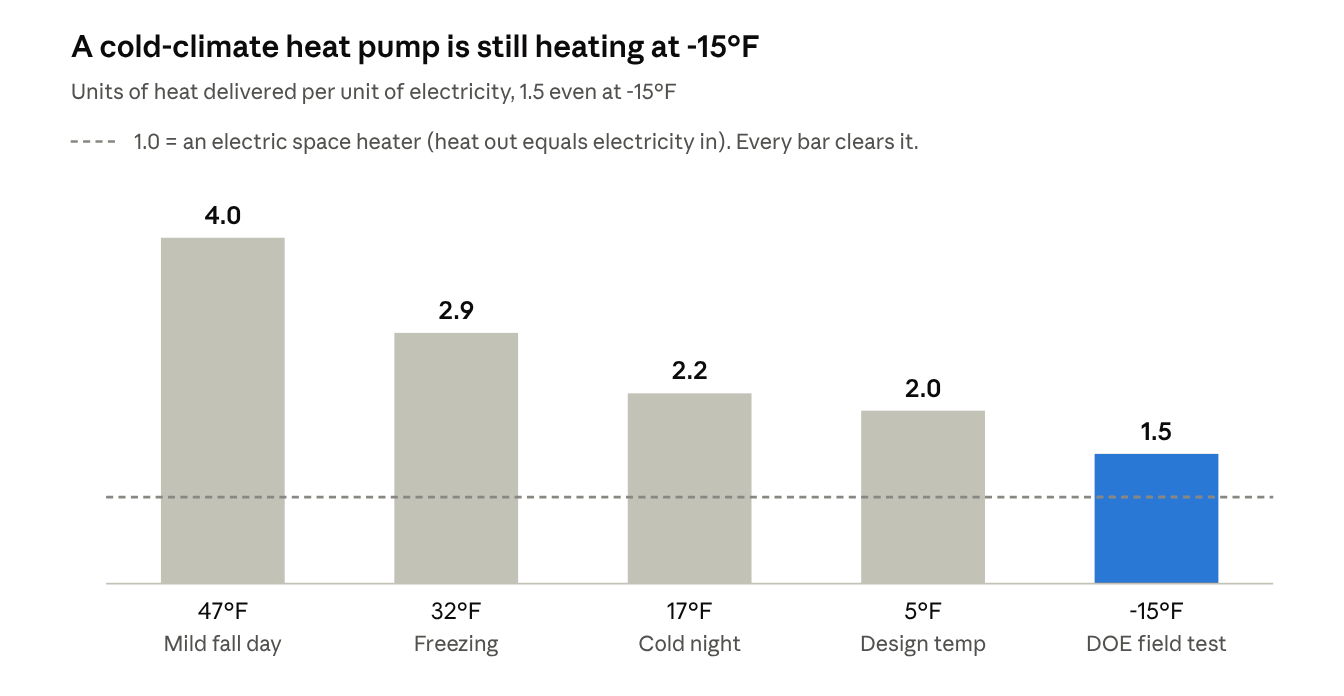
Typical cold-climate heat pump COP: DOE, NEEP and manufacturer data; -15°F from the DOE field validation (PNNL).
Sources: DOE Energy Saver, heat pump systems · NEEP cold-climate heat pump specification · DOE Cold Climate Heat Pump Challenge · PNNL, DOE cold climate heat pump field validation. Typical values; manufacturer figures vary by model.
Efficiency drops as the air gets colder, but the heat pump never stops heating: every bar stays above the 1.0 line, and at 5°F it still delivers about 2.5 times the heat an 80% furnace gets from its gas. But COP isn't what keeps a house warm. Capacity is: how many Btu the unit delivers at your coldest hours compared with how fast the house loses heat. Real installs bear this out. In the DOE's field validation, 22 homes ran through winters down to -15°F with little help from backup heat. The field data is in do heat pumps work in cold weather?
That's why our engineers design to the county's 99% heating design temperature: 3°F in Denver and Fort Collins, 0°F in Boulder, 7°F in Colorado Springs, per the ENERGY STAR design temperature reference. We run a Manual J load calculation (the room-by-room heat-loss method) from a scan of your house, then pick equipment whose 5°F capacity covers it with margin. The cold-climate lines we install (Mitsubishi Hyper-Heat, Bosch, Daikin cold-climate, Carrier Greenspeed) hold 70% to 100% of their rated capacity at 5°F and keep running to about -13°F. The capacity line is on your quote, so you can see the margin before anything is installed.
How that sizing works, and how to check a quote for it, is in what size heat pump do I need?
One homeowner put the worry plainly on an intro call: "Will it actually keep up when it's below zero? That's the only thing I care about." When the answer has been no, the cause is almost always a standard heat pump where a cold-climate unit was needed, or a unit sized by square footage instead of a load calculation. What separates the two is covered in what qualifies as a cold climate heat pump.
Will a heat pump cost more to run than my gas furnace?
No. Judge running cost over the whole year, because a heat pump replaces two systems: the furnace in winter and the air conditioner in summer. On Xcel Energy's default time-of-use rate, a typical Denver home spends about $750 a year to heat and cool with a cold-climate heat pump, against about $880 for a 15-to-20-year-old furnace and air conditioner. That's about $130 back every year, about 15% of what the old pair costs, and the chart shows where it comes from.
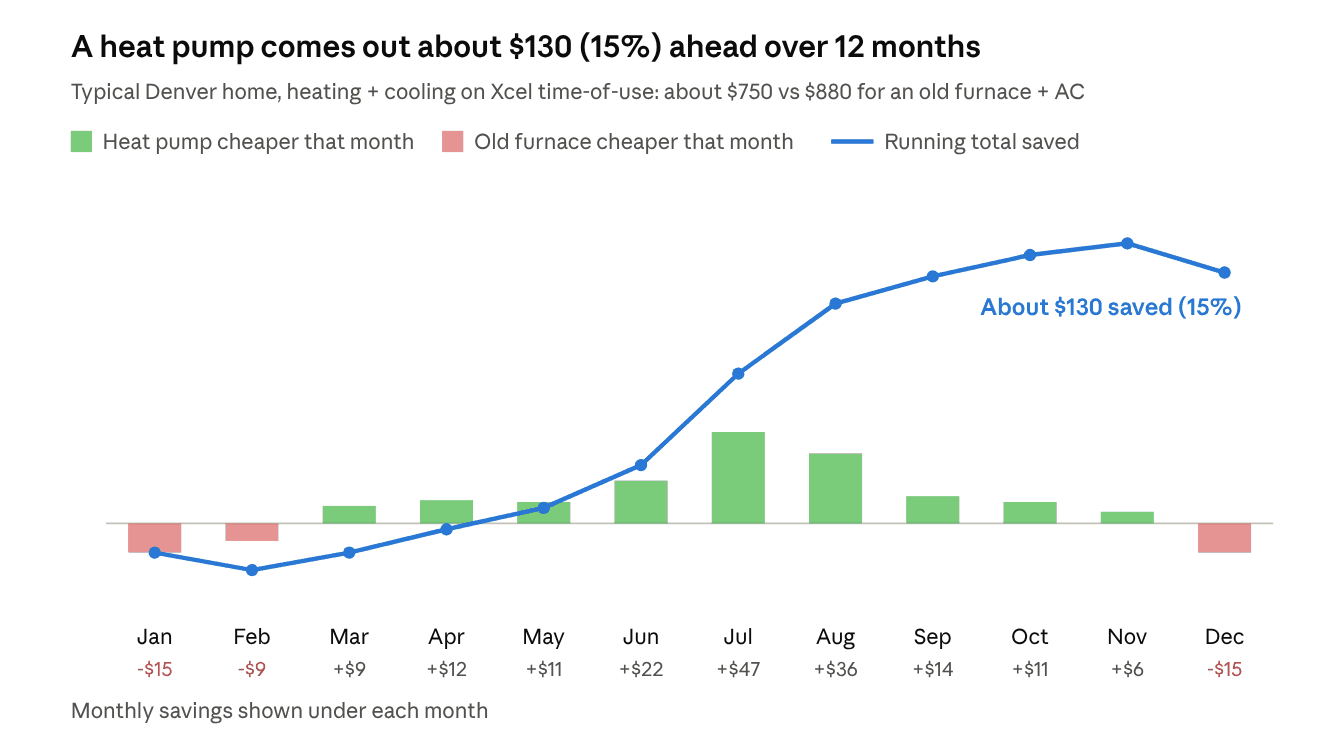
Zero Homes model: Denver normal monthly temperatures, Xcel time-of-use electricity and $0.95/therm gas, old furnace at 72% delivered and old AC at SEER 8.5.
The savings come in all year. Spring and fall are cheap months for a heat pump, because at 40°F to 60°F it delivers 3.5 to 4.4 units of heat per kWh. Summer is the biggest win: a modern heat pump cools on about half the electricity of a 15-year-old air conditioner, worth about $105 from June through August, with cooling costs cut about in half. Only in December through February, when the outdoor average drops below about 36°F and gas is cheap, does the old furnace cost a little less to run, about $39 over the three months, and the other nine months pay that back four times over. Even against an 80% furnace in good shape, the year nets about $65 (about 8%) in the heat pump's favor. The month-by-month math, including other rate plans, is in heat pump vs furnace: what each costs to run in Colorado.
Should I keep my furnace as backup? How a dual-fuel heat pump works
A dual-fuel system pairs a cold-climate heat pump with a gas furnace on one thermostat. The heat pump handles all the cooling and most of the heating; below a switchover temperature you choose, the furnace takes over. Set at the 36°F cost crossover, the furnace runs about three months a year and the heat pump runs the rest. It's the setup that uses each heat source only where it's cheapest.
| Setup, typical Denver home | 12-month cost |
|---|---|
| 80% furnace + 15-year-old AC | About $813 |
| Cold-climate heat pump alone | About $748 (about 8% less) |
| Dual fuel: heat pump + 80% furnace | About $676 (about 17% less) |
Modeled on Xcel's time-of-use rate at $0.95 a therm, with Denver's normal monthly temperatures, and the same cold-climate heat pump in both heat pump rows.
Dual fuel makes sense when:
Your furnace is in good shape and you'd rather not retire it yet.
Your home is in the mountains and sees -20°F nights, where a heat pump runs at reduced capacity.
You want gas as a safety net for the few coldest days.
A heat pump alone makes more sense when the furnace is near the end of its life, since you'd be paying to keep a system you're about to replace, or when getting off gas is the goal. The full comparison, including switchover settings and trade-offs, is in is a dual-fuel heat pump worth it in Colorado?
How do I know I'm getting a good cold-climate heat pump?
The COP numbers above only hold if the equipment and the install are right. Start with five lines on the spec sheet:
| Spec-sheet line | What to look for |
|---|---|
| HSPF2 (seasonal heating efficiency) | 8.1 or higher; 8.5 meets the DOE Challenge |
| COP at 5°F | At least 1.75; 2.0 or better is strong |
| Capacity at 5°F | 70% of the 47°F rating or better |
| Minimum operating temp | -13°F or lower |
| Certification | NEEP cold-climate or ENERGY STAR Cold Climate |
If a quote lists only SEER2 (cooling efficiency) and the old HSPF, ask for the HSPF2 and the 5°F capacity. A unit that can't show those wasn't designed for a Colorado winter.
Then look past the equipment, because the best value is the whole offer, not the lowest line item. A good quote shows a load calculation for your house, the unit's capacity at your design temperature, the manufacturer's warranty terms, and a commissioning check that the system holds temperature in heating mode. It should also net out what you'll actually pay: the rebates you qualify for and the financing available, including $0-down on-bill financing through CEF. Our checklist for comparing installers is in how to choose a heat pump installer.
What a cold-climate heat pump won't do
Hold its 47°F efficiency all winter. COP roughly halves by 5°F, so your January electric bill will be higher than October's, and in December through February an 80% furnace is a little cheaper to run. The year as a whole still favors the heat pump.
Perform like a cold-climate unit if it isn't one. A builder-grade heat pump without variable speed and vapor injection loses significant capacity below about 20°F and leans on resistance strips. The numbers in this post apply to cold-climate rated equipment.
Make up for a bad sizing job. The most common winter complaint traces back to a unit sized by square footage. Below its balance point, even a great unit falls behind.
Frequently asked questions
Every room comfortable. Finally. If you want to know what a cold-climate system sized to your home's design temperature would look like, we'll design one from a scan of your house and show you the engineering, no sales visit required. See how a cold-climate heat pump install works.