
Guide
Cheap HVAC installation: what's the catch?

Rich Jagisch
Director of Growth
6 minute read
11/17/2026
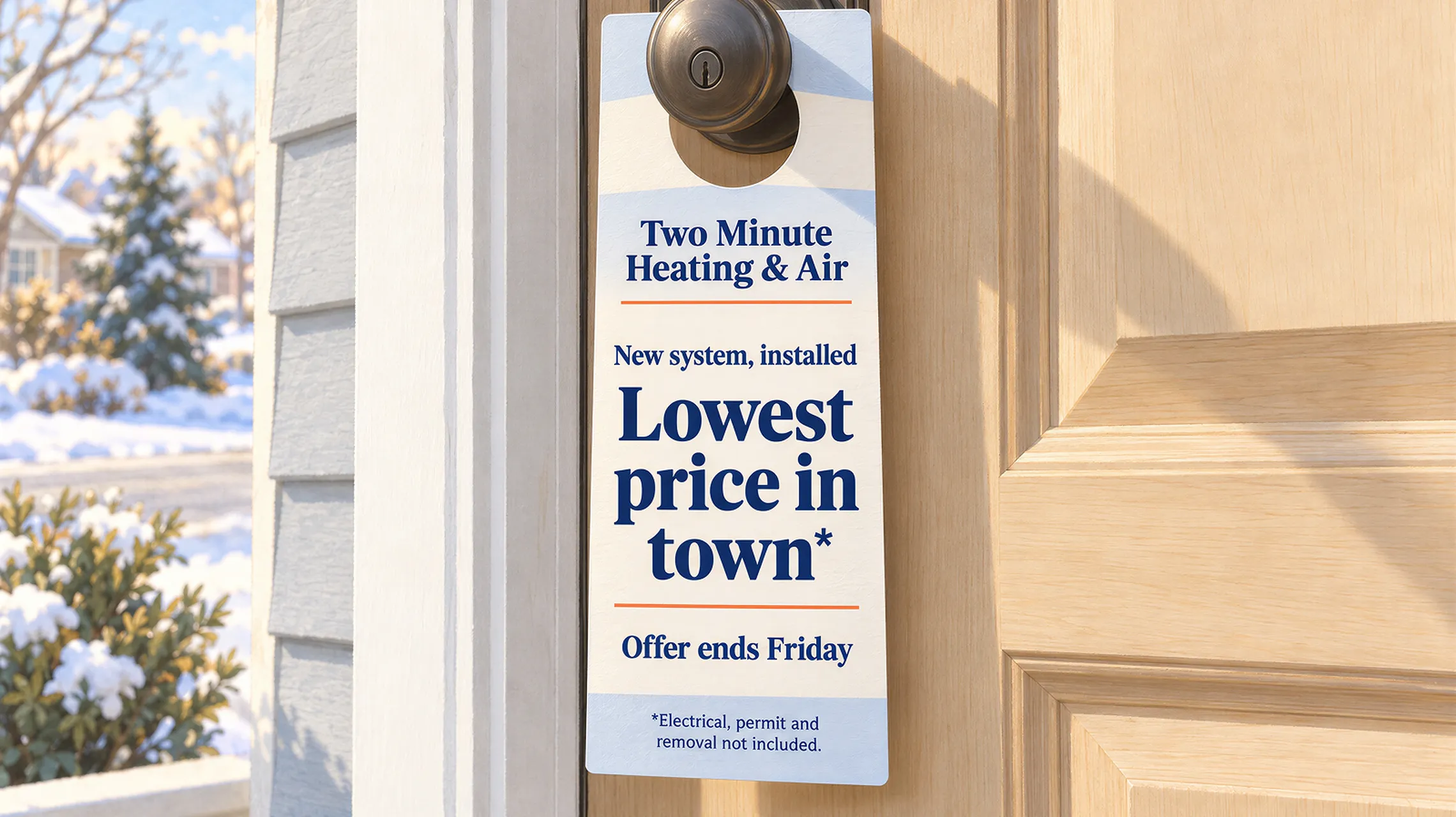
Sometimes there isn't one. A low bid can come from a small company with low overhead and an honest price. But more often a cheap HVAC installation is cheap for one of three reasons. The warranty is thinner. The electrical isn't included. Or the system is the wrong size.
None of the three shows up in the total. All of them show up later.
Here is how to tell a good low price from a bad one before you sign.
Key takeaways
A low bid isn't automatically a bad bid. Lower overhead is a legitimate reason for a lower price.
The three common catches are the warranty, the electrical and the size of the system.
A poor installation can cut a system's efficiency by up to 30 percent, according to ENERGY STAR.
The Federal Trade Commission advises against choosing the lowest bidder automatically.
The most expensive bid isn't automatically better either. Ask both to show their work.
Why is one HVAC quote so much cheaper?
Start with the fair explanation. Companies have different costs. One has a showroom, a fleet and a sales team paid on commission. Another has two trucks and an owner who answers the phone. The second can charge less for the same work and still do it well.
So a low price proves nothing by itself. What matters is what the price includes. When our sales team reads a low bid next to a higher one, the gap usually comes down to three lines.
| What's different | What the low bid often does | What it costs you later |
|---|---|---|
| The warranty | Covers parts only, with little or no labor | Labor on every repair after the first weeks |
| The electrical | Leaves it out, or marks it "by owner" | A separate electrician's bill |
| The size | Matches the old unit's label, with no calculation | Uneven rooms, short runs and extra wear |
The warranty. A manufacturer's warranty covers parts, not labor [1]. Labor is whatever the installer promises. If a bid doesn't state a labor term, assume there isn't much of one. Details are in HVAC warranty: what's actually covered.
The electrical. A heat pump sometimes needs a new circuit, and some homes need panel work. Published prices run from $570 for a circuit to $3,000 or more for a panel upgrade [2] [3]. A bid that skips the line isn't cheaper. It's incomplete. See does a new furnace or heat pump need electrical work?
The size. The proper way to size a system is a room-by-room calculation called a Manual J [4]. It takes time, so a fast bid often skips it and copies the size of the old unit. If the old unit was too big, the new one will be too. See what size furnace do I need?
Does the quality of the installation really matter?
A great deal. ENERGY STAR says improper installation can reduce a system's efficiency by up to 30 percent [5]. The equipment is the same in both cases. The difference is in how it was put in.
That's why ENERGY STAR publishes a checklist for comparing bids. It doesn't ask about price. It asks whether each contractor will calculate the size, check the existing ducts for damage, test for duct leaks and leave you the paperwork [6].
Those steps take hours. A bid that includes them costs more to produce than one that doesn't.
What is the cheapest HVAC system?
To buy, it's usually a basic gas furnace that replaces an old one. HomeGuide puts a new furnace at $2,000 to $5,400 [7]. A like-for-like swap reuses the existing gas line, ductwork and electrical circuit, which keeps the labor down.
Cheapest to buy is a different question from cheapest to own. We don't claim a more expensive system pays for itself. Gas costs less than electricity for the same amount of heat. The fair comparison looks at a full year, and it compares the old system you have with the new one you'd buy. That math is in heat pump vs furnace.
What we will say is narrower. A furnace typically lasts 15 to 20 years [8]. Whatever you install, you'll live with its size, its ducts and its noise for that long. The cheapest system is a poor bargain if it's the wrong one for the house.
How do I tell a good cheap bid from a bad one?
Ask the low bidder five questions. A good contractor will answer all of them without hesitating.
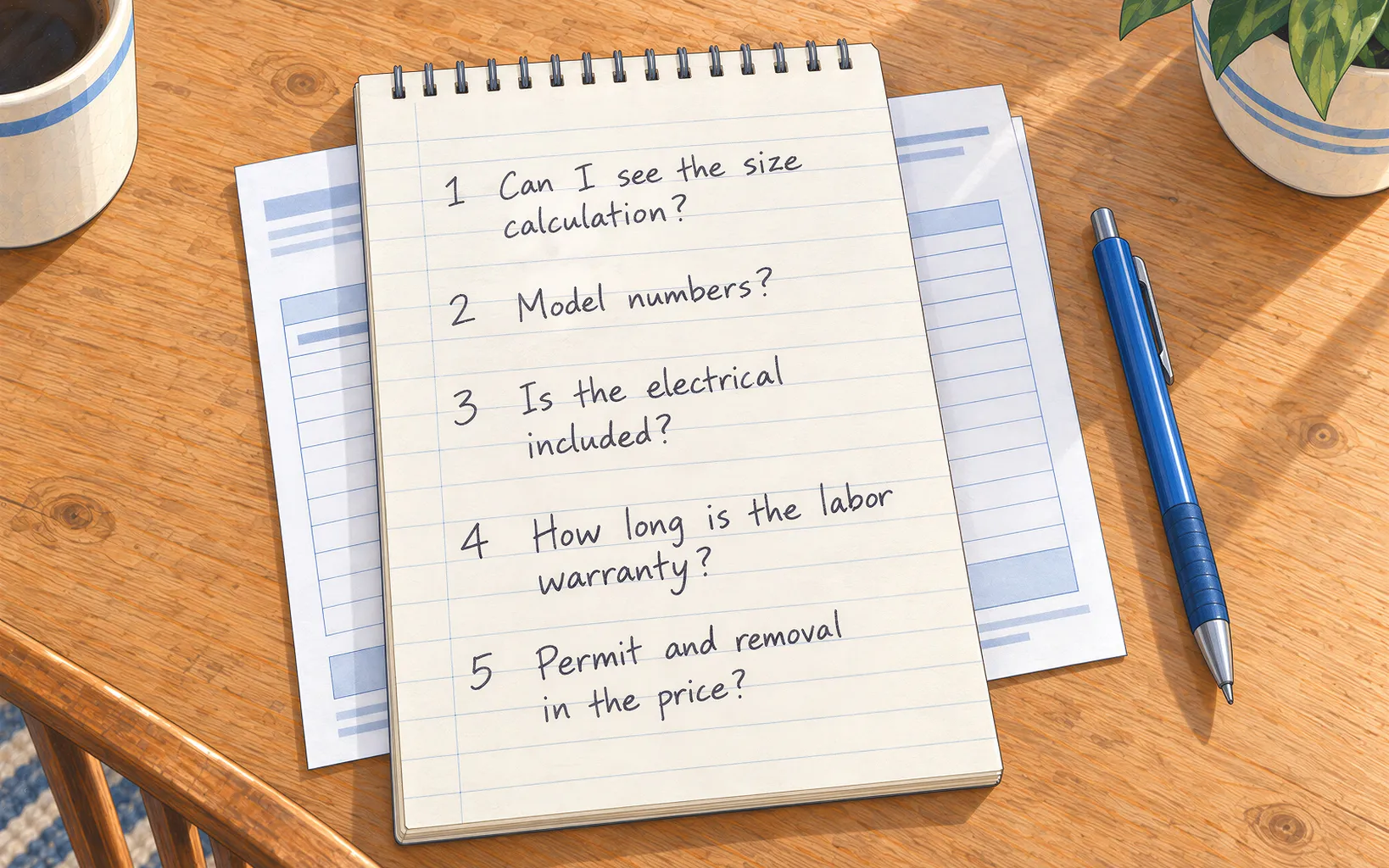
Did you calculate the size, and can I see the calculation?
What are the model numbers of the equipment?
Is the electrical included? Has anyone looked at my panel?
How long is the labor warranty, and who registers the equipment?
Are the permit and the removal of the old system in the price?
Then ask the high bidder the same five.
The Federal Trade Commission's advice on hiring contractors is to get more than one estimate and not to choose the lowest bidder automatically [9]. It also treats pressure to decide on the spot as a warning sign [9]. A price that's "only good today" is a sales tactic, whether the number is high or low.
We walk through the full method in how to compare HVAC quotes line by line.
When the expensive bid is the wrong one
It would be convenient for us to say you get what you pay for. It isn't always true.
A high bid can carry a large sales operation's overhead. It can include an extended warranty you didn't ask for. It can specify a larger or fancier system than the house needs. None of that makes the installation better.
The useful test isn't the price. It's whether the contractor can show you how they arrived at it. If you can see the reasoning, you can judge the number. If you can't, get a second opinion.
Frequently asked questions
Sources
Carrier, "Carrier warranty registration and information." https://www.carrier.com/us/en/residential/homeowner-resources/warranty/
HomeAdvisor, "How much does it cost to install a dedicated circuit?" https://www.homeadvisor.com/cost/electrical/cost-to-install-a-dedicated-circuit
Inch Calculator, "Cost to upgrade an electrical panel," updated August 14, 2023. https://www.inchcalculator.com/electrical-panel-upgrade-cost-guide/
Air Conditioning Contractors of America, "Manual J residential load calculation." https://www.acca.org/Manual-J
ENERGY STAR, "Heating and cooling." https://www.energystar.gov/saveathome/heating-cooling
ENERGY STAR, "Heating & air conditioning installation bid comparison checklist." https://www.energystar.gov/ia/home_improvement/heat_cool/HVAC_QI_bidsheet.pdf
HomeGuide, "Furnace repair cost." https://homeguide.com/costs/furnace-repair-service-cost
Lennox, "How long does a furnace last?" https://www.lennox.com/residential/lennox-life/consumer/how-long-does-a-furnace-last
Federal Trade Commission, "How to avoid a home improvement scam." https://consumer.ftc.gov/how-avoid-home-improvement-scam
A fair price is one you can check. Every Zero Homes quote shows the size calculation, the electrical and the warranty as separate lines, so you can hold it against any other bid. [See how a Zero Homes quote is built](/how-it-works).