
Guide
Cracked heat exchanger: repair or replace?

Rich Jagisch
Director of Growth
6 minute read
11/17/2026
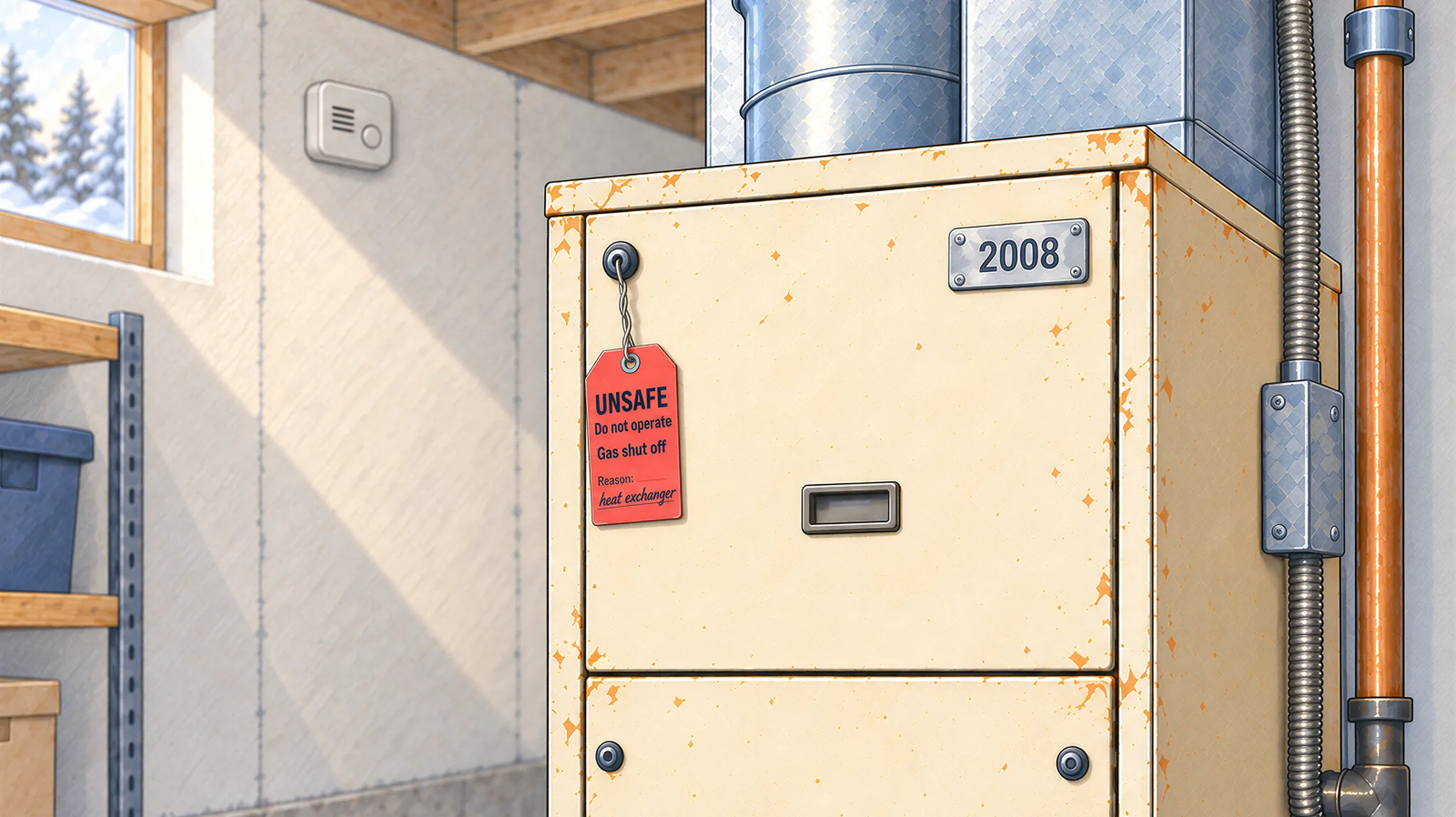
On a furnace more than 15 years old, replace the furnace. A new heat exchanger costs $1,000 to $3,000 [6], and it goes into a machine whose other parts are just as old. On a younger furnace, check the warranty before you do anything else. Some manufacturers cover the heat exchanger for 20 years [2].
Either way, don't run the furnace until it's been dealt with. A cracked heat exchanger can leak combustion gases into your home [1].
Here is what the part does, how to confirm the diagnosis, and how to decide.
Key takeaways
The heat exchanger keeps the furnace's exhaust apart from the air you breathe. A crack can let carbon monoxide through.
Replacing it costs $1,000 to $3,000. It's one of the most expensive furnace repairs.
Check the warranty first. The part may be covered for 20 years, though labor usually isn't.
Ask to see the crack, and consider a second opinion before a major decision.
Over 15 years old, the answer is almost always a new system.
What does a heat exchanger do, and why does a crack matter?
It's the metal chamber where the heat changes hands. The burners heat it from the inside. The fan blows household air across the outside. The air warms up without ever touching the flame or its exhaust [1].
That separation is the point. The exhaust contains carbon monoxide, which federal safety officials describe as odorless and deadly [3]. A crack breaks the barrier.
This is why technicians take it seriously, and why you should too. It's also why the Department of Energy lists checking the heat exchanger as a standard part of furnace maintenance [4].
What causes a heat exchanger to crack?
Carrier names two [1].
Age. The metal expands every time the furnace heats and contracts every time it cools. After many years, it fatigues.
Overheating. A clogged filter or blocked vents trap heat inside the furnace.
The second is preventable with a clean filter and open vents. Size matters too. Carrier notes that proper sizing and installation help reduce the stresses on a furnace [1]. We explain how to check yours in what size furnace do I need?
How do I know the diagnosis is right?
The warning signs are real but not conclusive. Carrier lists soot around the furnace, a yellow or orange flame and a carbon monoxide alarm [1]. It also notes that none of these confirms a crack, because each can have other causes [1].
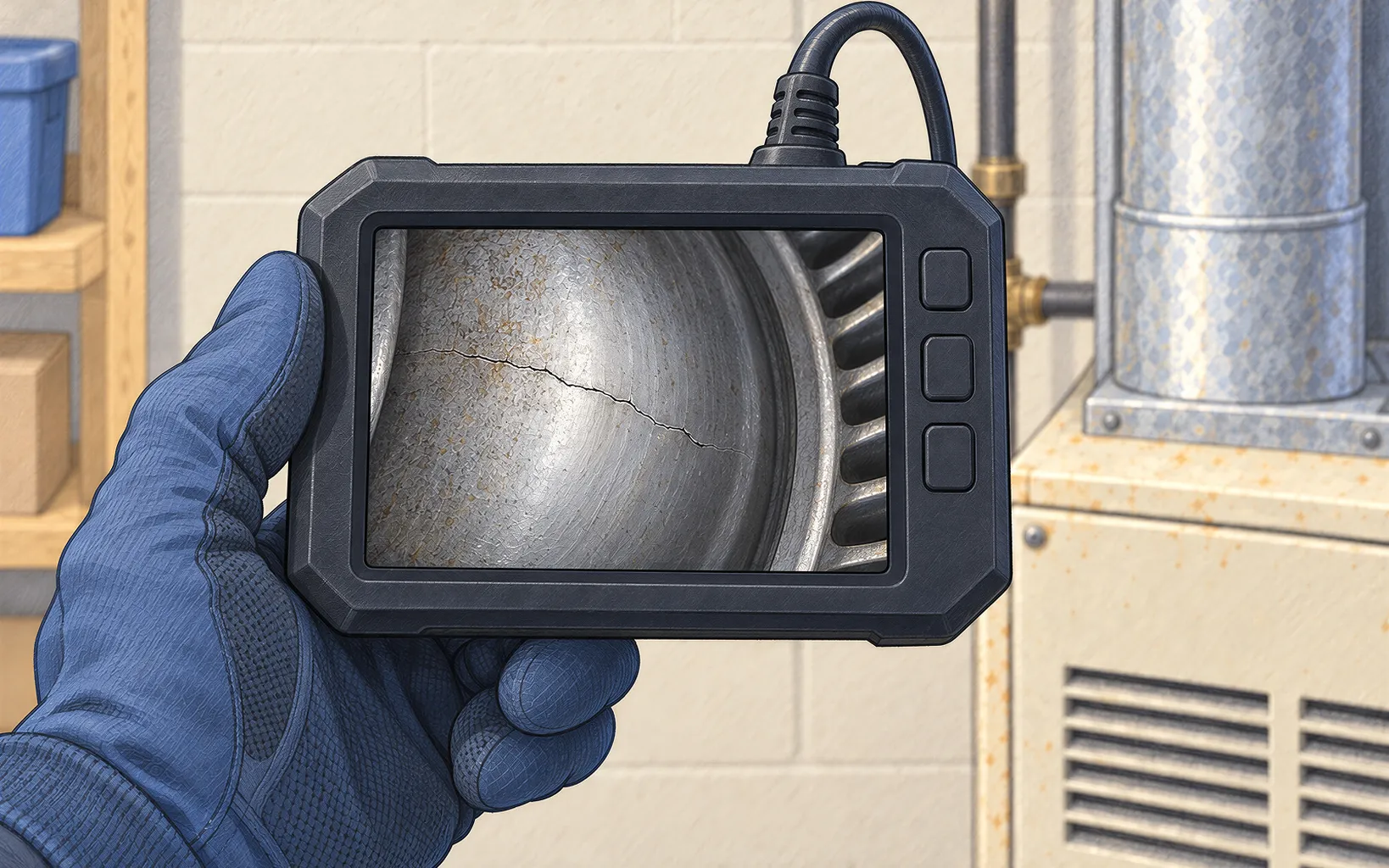
So the diagnosis has to come from an inspection. And you're entitled to check it.
Ask to see the crack. Carrier recommends a professional inspection whenever a crack is suspected [1]. So ask for the evidence. A technician who has found one can show you, in person or in a photo from an inspection camera.
Consider a second opinion. HomeServe recommends one for a major decision such as replacing a heat exchanger [5]. A different licensed contractor can confirm the finding. Keep the furnace off while you wait.
There's a reason for the caution. A cracked heat exchanger is a real hazard. It's also the diagnosis most likely to end in the sale of a new furnace. Both things are true, and a second look resolves which one you're dealing with.
What does a red tag on a furnace mean?
It means a professional has judged the furnace unsafe to run. A licensed technician or a gas utility inspector can issue one [5].
There are two kinds. One shuts the furnace down immediately. The other allows temporary use but sets a deadline for repair or replacement [5]. With the first kind, the gas to the furnace is usually shut off or the unit is disconnected [5].
A red tag isn't a suggestion, and restarting a tagged furnace isn't allowed. The furnace has to be repaired or replaced, then inspected again before the tag comes off [5].
Should I replace the heat exchanger or the whole furnace?
Start with the numbers.
| Option | Published cost |
|---|---|
| New heat exchanger | $1,000 to $3,000 |
| New furnace | $2,000 to $5,400 in one guide, $4,500 to $7,500 in another |
The heat exchanger figure is HomeGuide's [6]. The furnace figures come from HomeGuide [6] and HomeServe [5].
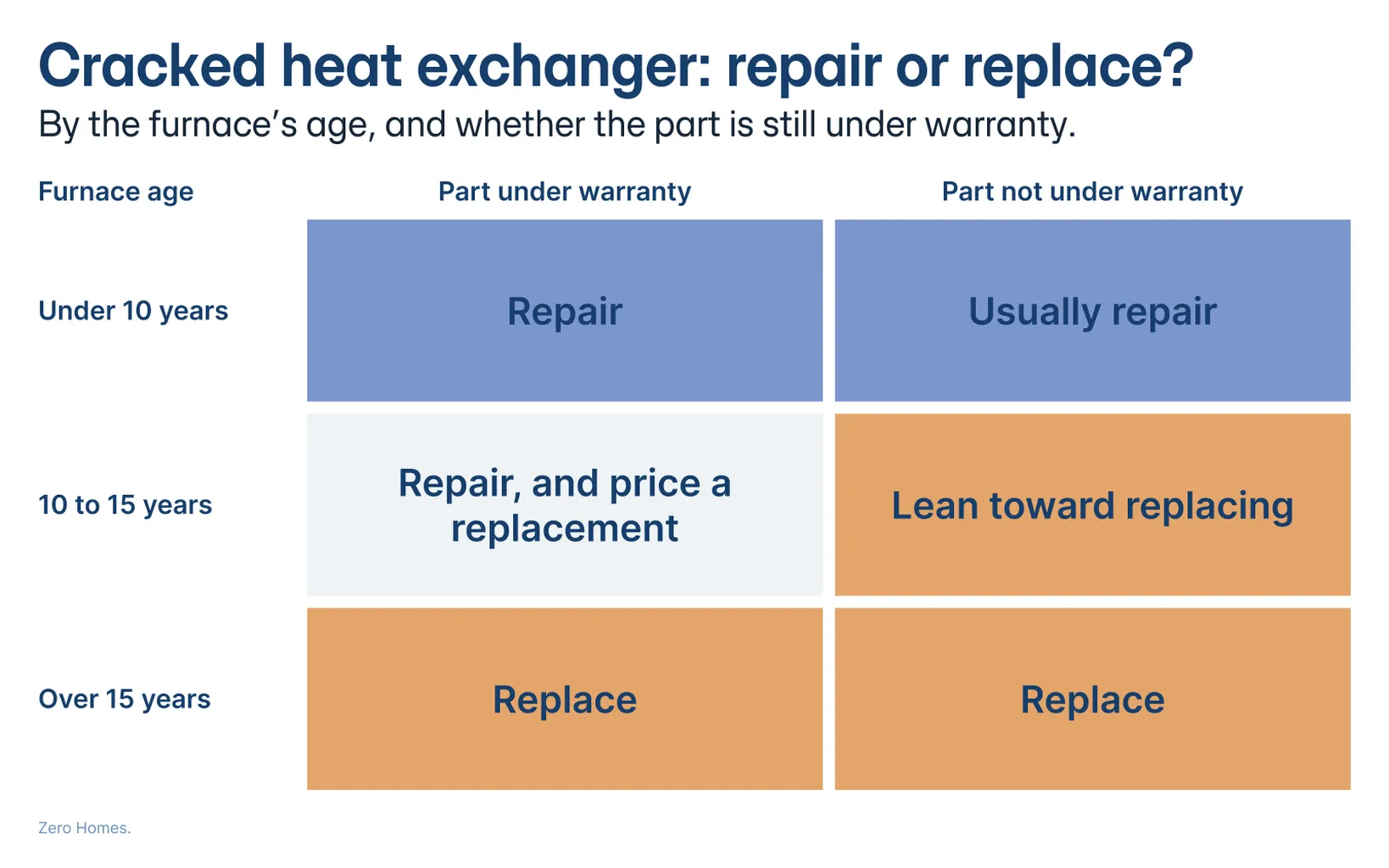
The repair can cost half as much as a new furnace, or more. That ratio is why age decides it. Here is how we'd read it.
| Furnace age | Part under warranty? | Our read |
|---|---|---|
| Under 10 years | Yes | Repair. You pay labor only. Ask why it failed so young. |
| Under 10 years | No | Usually repair, but get the cause explained first. |
| 10 to 15 years | Yes | Repair is reasonable. Price a replacement too. |
| 10 to 15 years | No | Lean toward replacing. |
| Over 15 years | Either | Replace the system. |
That table is our judgment, not a published rule. The reasoning is simple. A gas furnace typically lasts 15 to 20 years [7]. Past 15, a new heat exchanger is the most expensive part in a furnace whose motors, controls and valves are near the end too. HomeServe draws the line in a similar place, at 12 to 15 years [5].
One caution on the warranty. Coverage for the part doesn't include the work. Carrier's parts warranties don't cover labor [2], and Carrier itself calls replacing a heat exchanger a labor-intensive repair [1]. Ask for the labor price before you count on the warranty.
For the wider framework, see should I repair or replace my furnace?
What should I do right now?
Three things, in order.
Leave the furnace off. Don't restart it to get through a cold night.
Check your carbon monoxide alarms. Federal safety officials recommend one on every level of the home and outside sleeping areas [3].
Find the paperwork. The installation date and the warranty registration decide whether the part is covered.
Then take the time to decide properly. Being without heat creates pressure to sign whatever is put in front of you. The Federal Trade Commission lists pressure for an immediate decision among the signs of a home improvement scam [8]. A legitimate diagnosis will still be true tomorrow.
Zero Homes doesn't repair furnaces we didn't install, so we can't replace a heat exchanger for you. If the answer is a new system, that's work we do.
Frequently asked questions
Sources
Carrier, "Understanding heat exchangers," reviewed September 22, 2026. https://www.carrier.com/us/en/residential/hvac-resources/heat-exchanger/
Carrier, "Comfort 96 gas furnace," product page. https://www.carrier.com/us/en/residential/furnaces/59sc6.html
U.S. Consumer Product Safety Commission, "Keep warm and safe this winter: tips for using generators, furnaces and space heaters," January 23, 2026. https://www.cpsc.gov/Newsroom/News-Releases/2026/Keep-Warm-and-Safe-This-Winter-Tips-for-Using-Generators-Furnaces-and-Space-Heaters
U.S. Department of Energy, Energy Saver, "Furnaces and boilers." https://www.energy.gov/energysaver/furnaces-and-boilers
HomeServe, "What is a red-tagged furnace?" https://www.homeserve.com/blog/home-improvement/red-tagged-furnace
HomeGuide, "Furnace repair cost." https://homeguide.com/costs/furnace-repair-service-cost
Lennox, "How long does a furnace last?" https://www.lennox.com/residential/lennox-life/consumer/how-long-does-a-furnace-last
Federal Trade Commission, "How to avoid a home improvement scam." https://consumer.ftc.gov/how-avoid-home-improvement-scam
If your furnace has been shut down and you're weighing a replacement, our engineers can design one for your house from a scan you take with your phone. [See what furnace replacement looks like with Zero Homes](/services/furnace-replacement).